

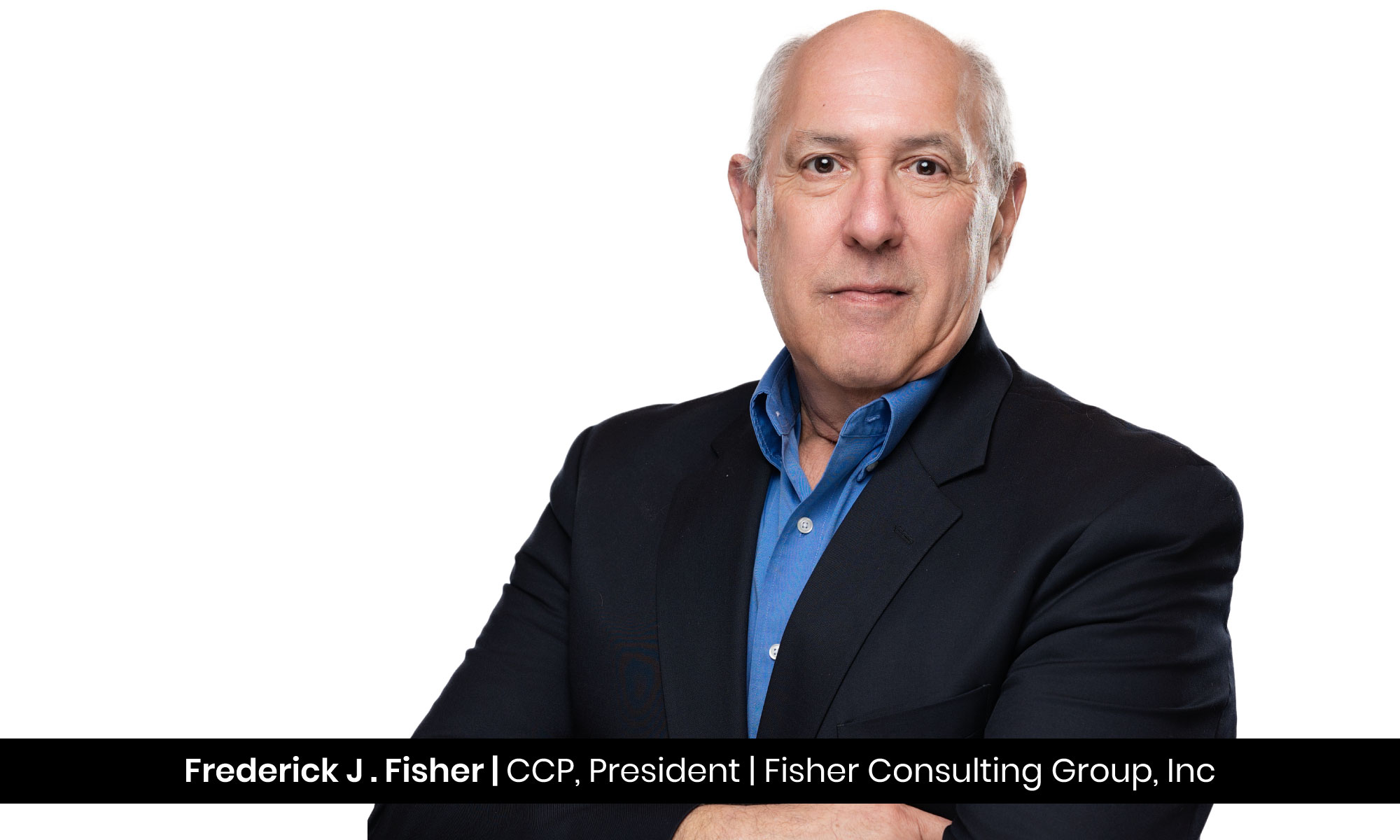
Some people walk into chaos when others are running out. When the pressure rises when it feels as if a bomb has gone off and everything is scattered, he steps in, not to panic, but to organize, question, and rebuild. Where others see numbers, premiums, and policies, he sees responsibility. Where others focus on price, he asks about protection. Where others chase revenue, he insists on standards.
Frederick J. Fisher, J.D., CCP, President of Fisher Consulting Group, Inc., has built his career on one unwavering mission: to make the insurance profession better, smarter, and more accountable than it was yesterday. From the very beginning, he was drawn to environments that demanded rigor. Hired on the spot early in his career because he was pursuing law at night, he learned quickly that knowledge was leverage and that discipline separated professionals from salespeople. In 1994, recognizing a gap in the marketplace, he opened a wholesale insurance brokerage, determined to support smaller agencies that lacked access and guidance in a system that often-favored volume over value.
But for him, this was never about volume. He challenges the industry’s most dangerous misconception: that all policies are alike and only price matters. He pushes back against what he sees as the “brainwashing” of clients into believing cheaper equals better. He reminds insurers that the claims department is not a cost center it is the promise being fulfilled. And he often quotes the old truth: you can lead a horse to water, but you can’t make him drink. He can provide the audit, the roadmap, the recommendations but implementation requires courage.
He does not take Expert cases simply to earn fees. He takes them because he believes in the principle behind them. In an industry where many shout “make money, make money,” he speaks about standards of care, about ethics, about raising the bar across all 50 states not just the 37 where your insurance professional is simply an order taker. At his core, his mission is simple but demanding: to make professionals better than they think they need to be. To make agencies accountable. To make brokers worthy of the trust placed in them. And ultimately, to make the system safer for the people it is meant to protect.
Five Decades of Insight into Claims-Made Coverage and the Complexities
Frederick entry into the world of professional liability was not the result of a grand plan it happened almost by accident.
At the time, he was working as a law clerk for insurance defense firms while attending law school. When a senior partner decided to replace him with a younger attorney who could immediately appear in court, he suddenly found himself without a position. Through friends, he secured an interview with a claim adjusting company that specialized in professional liability. He was hired on the spot. The firm valued individuals who were attending law school at night or had already graduated, and his background in a law firm made him uniquely suited to handle claims involving lawyers, insurance agents, brokers, real estate professionals, and other specialized risks.
From the beginning, the work intrigued him. Each claim involved a different underlying dispute, often complex and unexpected. He developed a reputation for obtaining strong statements and negotiating efficient settlements. He had found a niche where legal knowledge, analytical thinking, and practical negotiation skills converged.
It was there that he first encountered claims-made insurance policies a policy form he had not previously known existed. Even then, the structure was intricate, requiring careful analysis to determine whether a claim was first made within the policy period and whether the insured had prior knowledge of a potential claim at the time of application. Over the decades, those policies have grown even more complex. Nearly fifty years later, that complexity and the risks professionals face when they misunderstand it ultimately led him to write his book, driven by the same mission that has defined his career: to bring clarity to a form of coverage that can be deceptively dangerous if not fully understood.
A Career Built on Closing Dangerous Gaps
It did not take Frederick long to recognize that the insurance industry he entered in 1975 was far more complex than it appeared. Within a year, claims-made policies began evolving with new requirements, and by 1990 they had grown increasingly confusing, lacking standardization and even consistent definitions of fundamental terms such as “claim.” This inconsistency created significant potential coverage gaps and serious risks for policyholders.
At the same time, he observed a steady rise in claims against professionals’ real estate brokers, insurance brokers, attorneys, and others. As a claims adjuster, he saw firsthand that many of these claims were preventable. As early as 1978, he began delivering presentations and writing articles focused on loss prevention and risk education, a commitment he has sustained for more than five decades.
The idea was to prevent litigation, not to defend them.
His early career began at a claim adjusting company. Over time, he became a partner and sought to expand the firm’s services, ultimately buying out his partners and broadening operations into third-party administration (TPA) and qualitative claims auditing. However, as the business model of the industry shifted and adjusting remained the primary revenue source, he recognized the need for a new direction.
By then, he had built a strong professional profile, serving on the Board of Trustees of the Professional Liability Underwriting Society (PLUS) and publishing extensively in major insurance trade journals. In 1994, identifying a clear gap in the marketplace, he launched a wholesale insurance brokerage to better serve smaller retail agencies that lacked access to specialized expertise. His initial goal was modest to work with 300 smaller brokers. Instead, demand surged rapidly, and the firm soon found itself serving more than 1,500.
Drawing on his deep claims experience, he positioned the brokerage to provide retail brokers with something beyond access: true coverage backed by technical understanding. He recognized that professional liability policies are complex and potentially dangerous if misunderstood, requiring significant expertise to navigate properly. His transition reflected a defining realization: the industry did not simply need more products, it needed specialization, clarity, and education to protect professionals effectively.
Belief in the Case. Commitment to the Truth.
Frederick approaches his current Expert work with a standard that, to him, is simple: integrity first. If he is consulted and the facts are presented honestly, and those facts support the position being taken, he has no hesitation in standing behind it. But he takes on only the matters he genuinely believes in. Over the years, there have been occasions when the facts proved different from what was initially represented. In such situations, he has not hesitated to withdraw. At times, his own independent research has uncovered troubling evidence that forced him to reassess a case. If he concludes that he cannot testify truthfully or support the position with full conviction, he steps away. For him, cases are not revenue streams they are matters of principle. That clarity makes the ethical line easy to draw.
When it comes to consulting and audits, he is equally pragmatic. His role is to analyze, evaluate, and make informed recommendations. What clients ultimately choose to implement is their decision. As he often puts it, he can lead a horse to water, but he cannot make it drink. Still, he believes that if an organization invests in an audit, it should seriously consider acting on the findings.
In claims auditing, for example, he has recommended increased staffing levels when analysis showed that doing so could dramatically reduce losses in some projections, yielding savings of five to one. In some cases, the results were even stronger. In others, they were more modest. But he understands that outcomes depend not only on recommendations, but on commitment to execution. For him, success is not about offering advice it is about ensuring that sound analysis, when properly implemented, creates measurable improvement.
Decoding the Five Triggers That Control Your Protection
Before Frederick ever stepped into a courtroom as an expert witness, he spent years inside the machinery of the insurance industry itself.
He began as a claims adjuster on the front lines, where coverage decisions are made under pressure and facts matter more than theory. There, he learned how policy language translates into real-world consequences. He saw firsthand how documentation, investigation, and timing can determine whether a claim stands or falls.
From there, he moved into the role of wholesale broker, operating at a different altitude of risk. Instead of evaluating losses after the fact, he was structuring coverage before losses occurred. He learned how policies are negotiated, how exclusions are crafted, how underwriting intent is communicated and sometimes misunderstood. He saw how ambiguity enters contracts and how expectations diverge long before disputes arise.
Those years built a rare dual perspective: how insurance decisions are made internally, and how they are later defended externally.
Only after working on both sides of risk did Frederick step into expert witness and consulting work. By then, he wasn’t approaching disputes from theory. He understood the operational realities behind them. He knew how claims files are built, how brokers communicate with carriers, how underwriting decisions are documented and how gaps occur.
That background fundamentally shapes how he approaches litigation.
Beyond litigation, he challenges one of the most pervasive misconceptions in the insurance industry: the belief that all policies are essentially the same and that price is the only meaningful difference. He strongly rejects that notion. In his view, this price-driven mindset fueled by relentless advertising about savings obscures the far more important issue of coverage quality. A lower premium may come at the cost of narrower protections, restrictive definitions, or complex triggering requirements that leave professionals exposed when a claim actually arises.
This concern is particularly acute in the realm of professional liability insurance. Many assume that a history free of claims guarantees future safety. He knows from decades of experience that this assumption is dangerously flawed. The real risk lies not in the premium paid, but in the possibility that coverage may fail when it is most needed.
It was this urgency that led him to write the book Claims Made Insurance: The Policy that Changed the Industry. In it, he explains how claims-made policies have become increasingly complex, sometimes requiring multiple conditions to be satisfied before coverage is even triggered. These policies, he argues, can be among the most hazardous if not fully understood. The Insurance Journal later described the book as “an irreplaceable classic,” a recognition that reflects his broader mission: to replace complacency with comprehension, and price-driven decisions with informed judgment.
Guiding Professionals Toward Service, Standards, and Sustainable Success
At this stage of Frederick’s career, growth is no longer the goal. He has already built and led companies and trained hundreds of employees. He has experienced the scale, the expansion, the intensity and the rewards that came with it. Now, he chooses something different. He does not seek to grow bigger; he seeks to remain purposeful. He may be gradually winding down, but he still wants a reason to get up in the morning and for him, that reason is continuing to guide, advise, and protect.
When professionals reach out to him, his first step is simple: he listens. He tries to understand whether they are open to examining their practices from a different perspective. If he mentors them, he is careful not to push them into positions that might conflict with their leadership’s expectations. He knows that many agencies and organizations operate under an investors’ relentless pressure to produce revenue to “make money, make money, make money.” In that environment, quality, service, and long-term risk management can easily be overshadowed.
He believes that mindset is short-sighted. For him, professional responsibility must balance production. Service, education, documentation, and risk management are not obstacles to profitability, they are the foundation of sustainable success. Advising clients properly, documenting that guidance, and helping them understand their exposures reduces litigation and strengthens relationships. Closing deals is necessary, but it cannot come at the expense of integrity or diligence.
He navigates this tension carefully. So far, he has been fortunate not to create friction for those who seek his counsel. His approach is practical, not confrontational. And he holds to one principle with certainty: if you truly help clients manage their professional risks, you will not just close a transaction, you will earn their loyalty for life.
Turning Insurance into Protection and Claims into Purpose
Frederick recognizes that establishing a uniform standard of care for insurance brokers across the United States is unlikely under the current regulatory structure. Standards are determined state by state, and while he would personally advocate for a far stricter and nationally standardized benchmark particularly in the 37 states where expectations remain relatively low, such reform would require legislative action. Organizations like the National Association of Insurance Commissioners may draft model acts, but they have not taken a definitive position on elevating the professional standard of care. For him, that gap represents unfinished work.
In both litigation and consulting, his mindset is straightforward: if he does his job with integrity, clarity, and intellectual honesty, clients and their attorneys will return. Reputation is not built through marketing, but through consistent credibility.
His philosophy toward the industry is equally direct. Insurance should never be sold merely as a means of generating revenue. It should be positioned as financial security. If professionals focus on truly protecting clients, profitability will follow naturally. Conversely, buying or selling based solely on price undermines long-term stability and increases exposure to risk.
He is particularly emphatic about the role of the claims department. Too often, organizations treat it as a cost center to be minimized. He strongly rejects that view. In his eyes, the claims department is the true profit center of an insurance company. The product is not the policy itself, it is the proper handling, payment, and resolution of claims. Investing in qualified staff, reducing caseloads, and resolving files efficiently leads to faster and lower settlements and stronger financial performance over time. Cutting corners in this area may appear economical in the short term but proves costly in the long run.
He remains committed to staying current with the case summaries he electronically receives regarding evolving case law and coverage decisions, knowing that professional liability is constantly shifting. And the principles he leaves behind are simple but unwavering:
- Provide financial security to your clients, let competitors merely sell insurance.
- Never sell or buy on price alone.
- Ensure clients understand their responsibilities under their policies.
- Recognize that the claims department is not a cost center it is the engine that sustains the company.
After each matter concludes, he may feel worn out, sometimes relieved but always ready for the next challenge, guided by the same enduring belief that professionalism, properly practiced, protects everyone involved.