

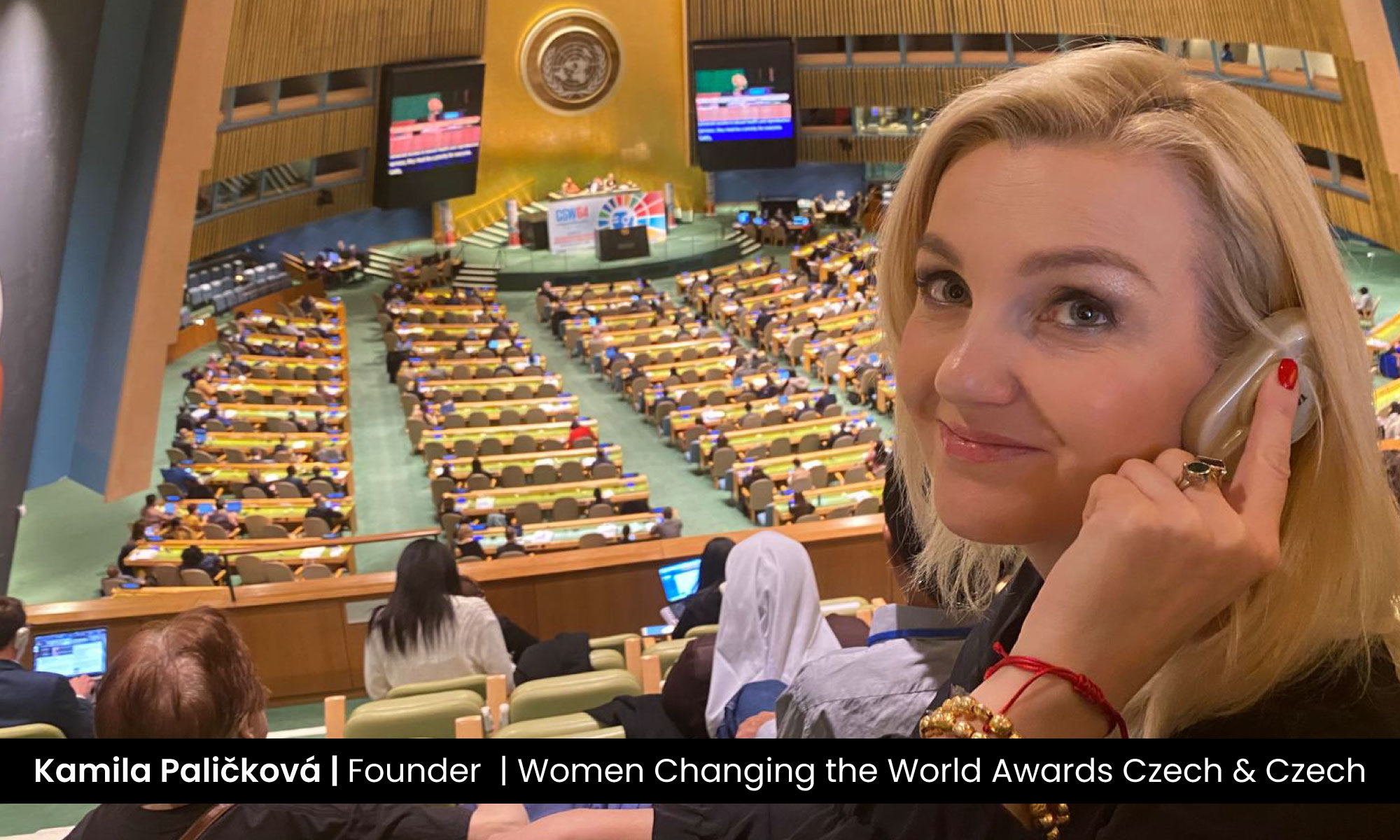
For years, Kamila Paličková did everything right. She worked hard. She delivered results. She followed the unspoken rules be capable, be reliable, be modest. Like many women, she learned early that excellence was expected, but visibility was optional. Confidence was admirable, but only in measured doses. Success was acceptable as long as it didn’t disrupt the comfort of the system around her. And so, she mastered the system. She built, optimized, executed. She understood how structures functioned and how to move within them efficiently. From the outside, everything looked aligned. Inside, something felt mechanical. She was achieving outcomes, yet feeling disconnected from them. It was as if she had learned to operate like a machine productive, logical, effective but not fully alive.
The realization did not arrive early. It arrived late after years of functioning on autopilot. She began to notice something unsettling: many people around her were living the same way. Entire systems were designed to function logically, but not necessarily consciously. We were taught strategies, hacks, and formulas but rarely taught to question the instructions themselves. We were encouraged to adapt, improve, and perfect yet rarely invited to ask who we truly were beneath the adaptation.
Nature showed her something different. Growth was not optimization; it was expansion. Life was not performance; it was presence. A human being was not a machine only trained to behave like one. That shift marked the beginning of something new. A gradual expansion of awareness. A reconnection to emotion, perception, and choice. She stopped reacting to expectations and began choosing consciously. She stopped chasing perfection and started questioning the structure that defined it.
And then came the deeper insight: society does not transform merely through laws or policies. It transforms through recognition. Through who we accept as natural authority. Through whose voice feels legitimate in shaping reality. She saw clearly that many women were still raised to be hardworking and kind but not visible and confident. The world would not change simply because women worked harder. It would change when women stopped shrinking. That understanding led her to create something that was not just an award but an environment.
As Founder of the Women Changing the World Awards Czech & Czech, Kamila envisioned a space where women could see themselves differently than their past had taught them to. A space where achievement was not minimized. Where leadership was not softened to be palatable. Where women were recognized not only as supporters of systems but as creators of them.
She did not learn these lessons early. She learned them through lived experience through achievement without fulfillment, through adaptation without alignment, through performance without presence. And perhaps that is precisely why her work carries weight. Because she does not speak from theory. She speaks from awakening.
Kamila Paličková did not set out merely to optimize success. She set out to understand what truly creates it. And in doing so, she began building a new narrative one where women do not shrink to fit the world, but expand until the world changes shape around them.
The Journey Toward Wholeness
It was not a single dramatic turning point, but a gradually intensifying sense of emptiness and emotional disconnection. Kamila functioned with remarkable efficiency yet more like a system than a human being. Operating on autopilot, she achieved measurable results, but felt little connection to them. At the same time, she observed many others living in a similar pattern. Society seemed to be chasing an ideal of perfection that was, in reality, only a highly refined adaptation.
That world taught her discipline, strategy, and responsibility. However, she began to recognize a deeper flaw within it: outcomes were evaluated without regard to the internal state from which they were created or the true value they carried. Two individuals could produce identical performance one driven by fear and pressure, the other guided by integrity and purpose—and the system would not distinguish between them. Yet over time, those internal differences shape entirely different realities.
This awareness culminated in a profound personal crisis of identity and values professionally described as a psychospiritual crisis. Increasingly common in modern society, such a crisis reflects not traditional burnout, but the collapse of an outdated definition of the self. It arises in cultures that continue to act, grow, and generate wealth, yet often lack meaning. For her, it marked both an ending and a beginning: the dissolution of an old identity and the gradual expansion of consciousness, emotion, and perception.
In that space of reckoning, she realized she no longer wanted merely to optimize performance she wanted to understand what truly creates performance. She came to see that authentic leadership does not begin with strategy, but with the quality of consciousness from which action emerges. That moment signalled the end of the “game of success” and the beginning of a search for wholeness.
As she moved within international environments, another paradox became clear. In Central Europe, she encountered countless capable women transforming their industries, communities, and families yet many did not see themselves as leaders. Cultural conditioning had taught them to be diligent and supportive, but not visible. They waited for validation that rarely arrived because they had been raised not to stand out, but to follow direction.
The creation of the Women Changing the World Awards Czech & Czech was therefore not merely about recognition. For her, it became a tool for shifting collective perception. She understood that society does not evolve solely through policies or programs, but through whom it acknowledges as natural authority. When women are recognized not only as contributors to existing systems but as architects of them, the perception of reality itself begins to shift.
Her vision was to create more than an award it was to build an environment. A space where women could, often for the first time, see themselves differently than their past narratives had allowed. A space where they could recognize that their work was never “small,” only untranslated into the language of authority and visibility.
At the same time, she envisioned the platform as a place to open conversations society tends to avoid. She believes that transformation cannot occur where truth is hidden. Only when honest light is cast upon what remains in the shadows can meaningful change begin.
A Shift in Collective Consciousness
Kamila believes the very framing of the question cooperation or competition reveals how conditioned society is to think in binaries. As if one must constantly choose between empathy or performance, linear or complex, feminine or masculine. In her view, reality does not operate in such divisions. Much of the tension in society arises not from the existence of opposites, but from the impulse to eliminate one side altogether.
For her, cooperation is foundational to human existence. People are inherently social beings, and everything they build from families to corporations emerges through relationships. Trust, stability, and long-term value are born from the ability to collaborate and co-create. Without cooperation, systems fragment.
Yet she also recognizes that development requires a certain form of natural competitiveness. Not competition rooted in domination or ego, but one that inspires growth. In its original sense, the word “competition” means to run together a shared forward movement. The presence of others striving toward excellence can elevate everyone involved, pushing individuals beyond perceived limitations.
The problem, she observes, occurs when one principle is absolutized. Pure competition can devolve into separation and struggle. Pure cooperation can slip into stagnation, indecision, or the suppression of individuality. Both carry light and shadow. The maturity of any system lies in its capacity to cultivate the constructive aspects of both simultaneously.
Within the Women Changing the World Awards Czech & Czech, she does not attempt to eliminate competition but to redefine it. Participants do not compete for human worth they are recognized for the quality and impact of their contribution. Women stand beside one another not as rivals, but as distinct expressions of creative power. When a person no longer feels compelled to defend her place, growth and mutual respect can coexist.
Her aim is not to create an environment devoid of tension, but one capable of holding it. The balance between cooperation and competition forms a living ecosystem dynamic, evolving, and generative. Not conflict, but movement. She is equally clear that the true impact of the awards does not culminate on stage. If the initiative ended with applause and photographs, it would remain a pleasant moment nothing more. Real transformation begins afterward, when a woman internalizes what the recognition signifies.
An award reshapes more than public image. It influences market positioning, external perception, and entry into public space. Yet if that shift does not occur internally, the recognition remains superficial information without integration. A woman may hold the title, but not embody it.
She witnessed this dynamic firsthand while building a company with several hundred salespeople. Time and again, she observed that techniques, strategies, and procedures alone produced limited change. Not because individuals lacked intelligence or effort, but because their internal self-image had not evolved. Competence expands only to the level of identity a person is prepared to sustain. Beyond that point, growth plateaus.
For this reason, her work with laureates extends far beyond the ceremony. She organizes trainings and webinars that focus not only on marketing or visibility, but on understanding intrinsic value and learning how to communicate it authentically. The objective is not merely to place a logo on a website, but to transform how a woman perceives and presents herself. When internal alignment shifts, external outcomes follow new opportunities, collaborations, and market responses. The award ceases to function as a label and becomes a role consciously embraced.
Ultimately, she sees her most meaningful contribution as awakening courage. She helps women step into spaces they might previously have avoided. This distinguishes her initiatives from conventional programs. They do not operate solely at the level of skill acquisition, but at the deeper layer of identity the source from which skill, influence, and impact derive meaning.
Rewriting the Narrative of Women in Public Space
In Kamila view, selection methodology can never be separated from cultural context. Operating in a post-communist region historically shaped by caution, conformity, and an unspoken expectation not to stand out, she understands how deeply these patterns influence professional behavior particularly among women. Many are still raised to be modest, diligent, and agreeable rather than visible, confident, and self-advocating.
In practice, this often means women wait for invitation instead of stepping into space independently. They prioritize delivering high-quality work but devote less attention to positioning themselves strategically. While men more frequently pursue opportunities proactively, women tend to wait for external validation. This dynamic inevitably influences career progression, compensation, and public recognition.
To address this, she introduced the principle of self-nomination within the Women Changing the World Awards Czech & Czech a step she considers symbolically essential. It is not merely an administrative requirement, but the first conscious act of claiming one’s value. Instead of waiting to be “discovered,” a woman acknowledges the significance of her own contribution. In a culture where confidence is often misinterpreted as arrogance, this gesture represents a profound internal shift.
Feedback confirms that transformation often begins at this initial stage. Many finalists and winners experience an intense psychological process marked by doubt, shame, or imposter syndrome. Some need time before publicly speaking about their recognition, as they first integrate what it represents. For her, this reinforces that the awards are not simply a competition they are a psychological transition.
The methodology itself is rigorous. Applicants complete an extensive questionnaire requiring several hours and detailed documentation of measurable results. Evaluation is conducted by an expert jury composed of respected figures from science, media, and business. This structure intentionally connects inner courage the willingness to step forward with external verification of tangible impact.
At the same time, the initiative became the first in the region to introduce a special award for men. This recognition is not jury-evaluated; she personally grants it as a symbol that advancing women’s position cannot arise in opposition to men. Sustainable social transformation rests on mutual respect and cooperation. Among those honored have been a man who openly addresses abuse prevention following his own experience, and a physician advocating for dignity in childbirth and respect for women lived experiences. For her, this represents a healthy dynamic not a gender battle, but conscious participation.
The ultimate result is therefore not only the selection of laureates, but a shift in mindset: from waiting to actively shaping professional reality, and from division toward balance in relationships between women and men. She also reflects on how leadership stereotypes have evolved. For decades, the dominant assumption was that women lacked competence to lead. Today, women can access leadership roles but often by adopting styles of functioning that were historically developed without them. In many environments, respect is still granted when a woman appears tougher, less emotional, and more traditionally decisive. In effect, she must resemble the established leadership model.
Yet this does not create balance; it merely extends the same paradigm to additional actors. Emancipation opened doors to public space, but it also generated subtle pressure to succeed through adaptation. Women gain positions, but the underlying system focused on performance, control, and relentless growth remains largely unchanged. That model, she believes, is now reaching its limits.
Society does not need women who function like men. It needs an expanded understanding of strength. The ability to perceive relationships, consider long-term consequences, hold complexity, and integrate care into decision-making are not weaknesses they are essential leadership qualities that have long been undervalued. If these dimensions do not enter positions of influence, imbalance will persist regardless of representation statistics. True change lies not only in increasing the number of women at the table, but in redefining what is recognized as power.
Paradoxically, she has observed that the moment a woman stops imitating an expected role and begins acting from her authentic nature, her leadership becomes most effective not only for herself, but for the entire environment she shapes.
The Energy Behind Sustainable Impact
In the wilderness, Kamila came to a realization that reshaped her entire understanding of leadership: a human being is not an observer of a system, but part of it. In nature, there is no clear separation between the individual and the environment. One exists within it as fully and as vulnerably as every other living being. Nature does not operate through rigid control, but through relationship dynamics. Out there, survival does not belong to the strongest or the most aggressive. It belongs to those who can perceive the whole the rhythm of the environment, the boundaries that must be respected, and the subtle energy of others. This awareness fundamentally altered her perception of leadership and human interaction.
Modern society, by contrast, is built on the belief that nature and even human behavior can be managed from the outside. Systems have been designed to function logically, efficiently, and predictably, yet not always in a way that feels alive. The more control is imposed, the more suppressed aspects of human nature resurface elsewhere in conflict, burnout, polarization, or a pervasive sense of emptiness. She came to understand that a human being is not a machine, only trained to function like one. Beneath every rational decision still lies instinct, the need for safety, belonging, recognition, and meaning. When systems ignore these deeper layers, they begin to fracture internally, even if they appear flawless from the outside.
Nature revealed another principle to her: balance is not achieved by eliminating tension, but by sustaining it. In a healthy ecosystem, strength and sensitivity coexist. Dominance and cooperation both have roles. Stability collapses only when one principle attempts to dominate the whole. Since that realization, she no longer defines leadership as the act of managing people. Instead, she sees it as the ability to hold space where differences can exist without escalating into conflict. The wilderness taught her respect not as a moral ideal, but as a prerequisite for survival. It also showed her the limitations of linear thinking. Complex systems require complex awareness.
In her experience, the most challenging aspect of growth is not structural organization, but energy. Projects rarely fail due to flawed strategies alone; they fail because they lose meaning as they expand. As scale increases, purpose often thins. For this reason, she does not equate expansion with enlarging a structure. She equates it with preserving the quality of relationships. An organization can grow only to the extent that it remains alive. The moment it begins operating purely mechanically, it may increase in size, but it ceases to generate genuine impact.
Practically, this means upholding clear principles and ensuring they are not diluted by operational demands. Decisions are evaluated not solely on efficiency, but on the internal state they cultivate within people. If growth erodes trust, authenticity, or relational depth, it weakens the system rather than strengthening it. She does not aspire to build a vast organization. She seeks to cultivate an environment capable of growth without losing its essence. To her, that is the defining distinction between a structure and an ecosystem.
Transforming Society by Transforming the Self
Kamila believes the most important task of a person is not to master another strategy or productivity hack, but to stop unconsciously adopting other people’s instructions. True growth begins with self-discovery understanding who one truly is, what one needs in order to live well, where one’s strengths lie, where vulnerabilities exist, and how one naturally function. In her view, a meaningful mentor does not offer universal formulas. Instead, a mentor guides a person inward. They create space for individuals to uncover their own principles and develop strategies aligned with their authentic nature. From that process emerges integrity a sense of internal coherence and, with it, genuine freedom.
Until a person feels internally free, external freedom remains an illusion. The timeless principle holds: what exists within manifests outwardly. This is one reason nature and animals inspire her deeply. They are fully aligned with their essence. They do not perform roles or chase approval. They simply exist in authenticity, and from that alignment comes a natural sense of freedom.
Modern society, however, is layered with expectations, roles, and constructed identities. People are told who they should be long before they discover who they are. Gradually, they disconnect from their inner compass and begin functioning according to external structures rather than internal truth. She often references the insight of Czech-born, world-renowned Egyptologist Miroslav Bárta, who describes one of the laws behind the collapse of civilizations: a system collapses when it requires more energy to sustain itself than it can generate. She believes this principle now applies not only to societies, but to individuals.
Today, many people expend enormous energy simply maintaining basic functioning. The volume of information, expectations, roles, and pressures is overwhelming. When life demands more energy than a person can internally produce, collapse follows in the form of burnout, anxiety, or a profound sense of meaninglessness. Increasingly, this is visible even among the young.
For her, self-knowledge is therefore not a luxury; it is foundational. It functions as a filter. When individuals understand who they are, they can navigate the constant stream of external stimuli with discernment. They stop reacting to everything and begin choosing consciously. And perhaps that is one of the most vital tasks of this era: finding the courage to be oneself. Only someone internally free can build healthy relationships, organizations, and societies.
She does not see the future of her movement as dependent on geography, but on collective maturity. In every country, there are individuals ready to create differently alongside structures still rooted in an outdated paradigm of performance and control. The coming years, in her perspective, are not about brand expansion, but about connecting environments. The aim is to gradually build an international network of people who bring a more conscious approach into sectors where decisions influence large segments of society education, healthcare, technology, media, and public administration.
Change is particularly necessary in these domains not because they are failing, but because they operate at scale. If the mindset of those making decisions remains unchanged, no technological or structural innovation will yield sustainable transformation. The ultimate objective is not to create another exclusive community, but to redefine the norm so that leadership is no longer associated with power over others, but with responsibility for the whole.
Kamila philosophy is captured in the reflections she often shares:
- “You don’t find your purpose by thinking. You find it by moving and becoming the person who can live it.”
- “Confidence isn’t built by approval. It is built by action before certainty.”
- “The world doesn’t change when women work harder. It changes when women stop shrinking who they are.”
- “Real leadership begins the moment you stop asking who allows you and start asking what wants to exist through you.”