

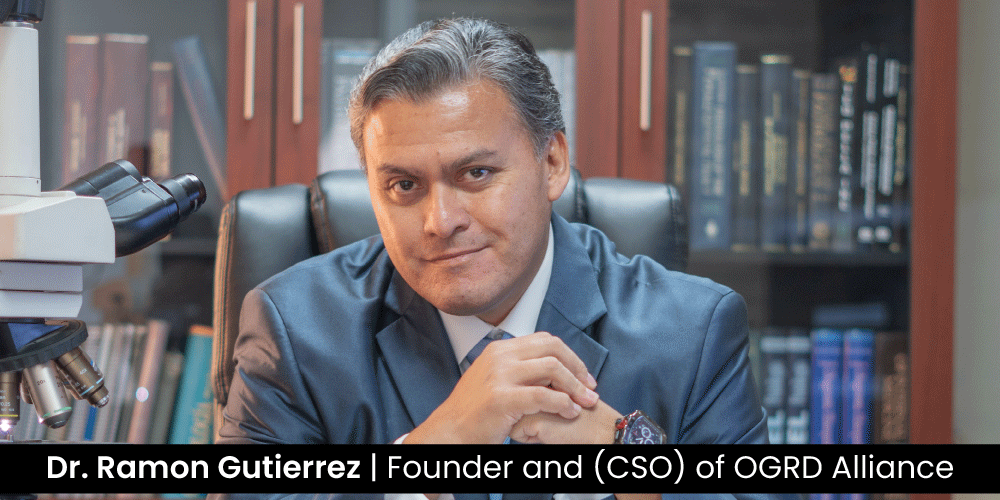
Long before titles or institutions, a single question shaped Dr. Ramón Gutiérrez’s work: what value does a medical breakthrough hold if it cannot reach the patients who need it most? Decades of progress in oncology have produced remarkable scientific advances, yet many of these innovations remain constrained by cost, complexity, and time. Through years of clinical and scientific practice, Dr. Gutiérrez came to recognize that much of the suffering associated with cancer is not inevitable, but structural.
Rather than following familiar paths of incremental improvement, he began to challenge the core assumptions of modern cancer therapy. He questioned why immune restoration was so often dependent on cellular replacement, genetic modification, or aggressive pharmacological intervention, and whether such approaches truly served patients’ dignity and long-term well-being. From this inquiry emerged a guiding conviction that has shaped his career: scientific progress without accessibility is an incomplete victory.
As Founder and Chief Scientific Officer (CSO) of OGRD Alliance, Dr. Gutiérrez leads with the belief that innovation must remain anchored in human dignity, responsibility, and real-world applicability. Under his leadership, OGRD Alliance was established to ensure that scientific breakthroughs are translated in ways that preserve their integrity while adapting to diverse healthcare realities, rather than forcing patients to conform to systems that exclude them. Dr. Gutiérrez understands that improving patient outcomes requires more than discovery alone. It demands parallel progress across science, regulation, manufacturing, logistics, education, and cost structure. A therapy delayed by a decade is, for many patients, a therapy denied. By rethinking how cancer treatments are designed, validated, and delivered, he is working to ensure that innovation arrives in time, at scale, and within reach. In Dr. Gutiérrez’s vision, hardship is not erased, but transformed into purpose. Each obstacle reinforces the commitment to build therapies that are not only scientifically rigorous, but also safe, scalable, and universally accessible—so that progress is meaningful, and no patient is left behind.
Redefining Cancer Immunotherapy Through Structural Immune Restoration
Dr. Gutierrez’s professional journey began at the intersection of medicine, pathology, and systems thinking rather than from a predefined entrepreneurial ambition. He was immersed early on in a discipline that compels one to see cancer not only as a clinical diagnosis, but as a structural and biological phenomenon one that reorganizes tissues, disrupts immune surveillance, and alters cellular communication. From the outset, his work focused on understanding why tumors behave as they do, not merely how to classify or treat them.
Early in his career, Dr. Gutierrez became acutely aware of a persistent disconnect in oncology. While scientific innovation was accelerating at an unprecedented pace, its translation into consistent, scalable benefit for patients remained uneven. Many promising therapies were extraordinarily complex, prohibitively expensive, or dependent on infrastructures unavailable to much of the world’s healthcare systems. This realization profoundly shaped his trajectory.
Rather than pursuing incremental innovation within established therapeutic paradigms, he began questioning the foundational assumptions of cancer treatment particularly the belief that immune restoration must depend on cellular replacement, genetic modification, or aggressive pharmacological intervention. His background in pathology allowed him to view cancer as a disease of disrupted biological architecture, especially at the immune–membrane interface, where spatial organization is as critical as molecular signaling.
Over time, this perspective evolved into a broader vision: the development of platforms rather than isolated therapies, and a focus on restoring immune functionality through endogenous, structurally coherent mechanisms. This vision ultimately led to the creation of the PLPC platform and later the OGRD Alliance, an organization designed to integrate scientific rigor, clinical reality, regulatory logic, and ethical responsibility into a single, scalable framework. Dr. Gutierrez’s career has thus been less linear progression and more an intentional convergence of disciplines aimed at redefining how cancer immunotherapy can be conceived and deployed globally.
At the core of this work is PLPC-DB™, a platform founded on a scientific principle that departs fundamentally from conventional immunotherapy paradigms. It asserts that effective immune restoration does not necessarily require cellular transplantation, genetic manipulation, or pharmacodynamic forcing. Instead, PLPC-DB™ operates at the level of structural immunobiology, addressing how immune cells organize, communicate, and execute function within a disrupted oncologic environment.
Cancer compromises immune competence not only through molecular signaling alterations, but by disorganizing membrane architecture, lipid–protein microdomains, antigen presentation platforms, and the geometry of immunological synapses. These structural disruptions impair immune recognition and coordination even when immune cells remain numerically intact. PLPC-DB™ is an endogenous, non-cellular, non-NCE immunobiological platform, based on phospholipoproteomic architecture, designed to restore these critical interfaces, enabling immune signaling to proceed with correct spatial and temporal organization.
Mechanistically, PLPC-DB™ functions as an architecture-first immune instruction system. It supports the restoration of lipid raft integrity, stabilization of co-stimulatory and adhesion complexes, and reconstitution of productive immunological synapse architecture (SMAC coherence). This approach is distinct from receptor agonism, checkpoint inhibition, or cytokine amplification; instead, it reconstructs the biophysical substrate required for endogenous immune signaling to function as intended.
By directly addressing the limitations of cellular and gene therapies, namely toxicity, manufacturing complexity, logistical fragility, and limited scalability, PLPC-DB™ offers a fundamentally different path forward. The platform enables reproducibility, proportional regulatory evaluation, and global scalability. In doing so, it positions itself as a complementary system capable of restoring immune terrain rather than replacing or overriding it.
“STIP™: Auditable, Mechanism-Driven Immune Traceability for Next-Generation Immunotherapy”
Dr. Gutierrez developed the Structured Immunophenotypic Traceability Platform (STIP™) to address a critical limitation in contemporary immunotherapy: the lack of auditable, reproducible immune characterization that can be compared across patients, batches, and regulatory jurisdictions. While many therapeutic programs focus primarily on clinical outcomes, STIP™ emphasizes making immune behavior itself traceable, interpretable, and quantifiable.
STIP™ integrates longitudinal immune phenotyping, functional biomarkers, and auditable traceability protocols within a unified, NAM-aligned framework, allowing immune responses to be documented as coherent, comparable fingerprints rather than isolated data points. Crucially, it is aligned with Real-World Evidence (RWE) methodologies, enabling data capture within routine clinical contexts without sacrificing scientific rigor.
For Dr. Gutierrez, STIP™ serves not only to track outcomes but also to make the underlying mechanism auditable. Because PLPC-DB™ is designed around nodal immune instruction and synapse restoration, STIP™ captures whether structural immune reconditioning is occurring as intended, including reproducible shifts in immune orientation, functional coherence, and signaling organization features that cannot be reliably inferred from animal models or early-phase trial endpoints alone.
By standardizing immune readouts and traceability criteria, STIP™ enables reproducibility across jurisdictions. Evidence generated in one region can be meaningfully audited and interpreted elsewhere, supporting regulatory dialogue, partner evaluation, and global deployment. In this way, STIP™ transforms immune modulation from a descriptive phenomenon into a structured, auditable process. PLPC-DB™ is thereby positioned as a de-risked pre-FDA asset, as its validation strategy aligns with the topology of its mechanism rather than with legacy development models designed for pharmacodynamic drugs or cellular interventions. The integration of STIP™ with New Approach Methodologies (NAMs) allows for proportional, mechanism-aligned validation that is both rigorous and biologically relevant.
Dr. Gutierrez designed PLPC-DB™ for localized intradermal supranodal delivery, targeting the dermal–lymphatic interface. This approach concentrates immune instruction at the lymph node—the immune system’s primary decision center, while minimizing diffuse systemic exposure. At the nodal level, antigen-presenting cells undergo structural reconditioning, restoring membrane microdomain organization and immunological synapse integrity. The resulting immune instruction then propagates systemically through normal physiological recirculation.
This architecture supports a fundamentally different validation logic. Rather than relying heavily on animal extrapolation or sequential Phase I–III trials optimized for pharmacodynamic agents, the STIP™–NAM integration allows safety, consistency, and functional immune coherence to be documented directly in human-relevant contexts. Longitudinal immune fingerprints provide auditable evidence of mechanism engagement, durability, and reproducibility.
Importantly, this approach does not compromise rigor. Instead, it replaces low-predictive, high-friction methodologies with proportionate, biologically aligned evidence generation. The result is a mature dossier that reduces development risk, accelerates regulatory dialogue, and supports responsible pathways toward patient access without compromising safety or scientific integrity.
OGRD Alliance: Bridging Scientific Innovation and Global Accessibility
Dr. Gutierrez established the OGRD Alliance guided by a fundamental principle: scientific innovation must be anchored in human dignity, accessibility, and responsibility. Framed as a “bridge between science and humanism,” the Alliance is committed to ensuring that advanced biomedical technologies are not confined to elite systems but are designed from inception to serve patients across diverse healthcare environments.
Strategically, OGRD Alliance operates from dual headquarters in Orlando and Dubai, reflecting this mission. Orlando situates the organization within a mature biomedical, regulatory, and academic ecosystem, providing access to clinical expertise, regulatory dialogue, and scientific collaboration. Dubai, in contrast, functions as a forward-looking hub positioned at the intersection of Asia, the Middle East, and emerging global markets. Its regulatory agility, advanced logistics infrastructure, and openness to non-traditional biomedical models make it ideal for deploying scalable, non-cellular platforms such as PLPC-DB™. Dubai also facilitates engagement with visionary capital that prioritizes long-term impact over short-term speculation.
Together, these two hubs enable OGRD Alliance to operate globally with coherence: developing science with rigor, validating it with transparency, and deploying it with ethical intent. Dubai is not merely symbolic; it serves as a structural inflection point for life-science innovation, aligning advanced logistics, mission-driven investment, and regulatory openness to non-traditional biomedical models. Its connectivity across Asia, the Middle East, Africa, and Europe support rapid regional deployment and coordinated access strategies for scalable platforms like PLPC-DB™.
Moreover, Dubai’s regulatory mindset is particularly receptive to proportionate evaluation of biomedical innovation, especially approaches aligned with New Approach Methodologies (NAMs) and Real-World Evidence (RWE) frameworks. This allows non-cellular immunobiological platforms to be assessed based on relevance and traceability rather than legacy development models. For Dr. Gutierrez, establishing a presence in Dubai is not just strategic but foundational: it enables the OGRD Alliance to design global accessibility from the outset, architecting scientific validation, regulatory engagement, and deployment strategies that address rapidly growing cancer burdens across Asia and the MENA region.
Restoring Immune Function for Real-World Impact
Dr. Gutierrez recognizes a persistent challenge in oncology: the widening gap between therapeutic innovation and real-world accessibility. Many advanced cancer therapies remain confined to highly specialized centers, limiting their practicality for public health systems and resource-limited regions. The OGRD Alliance was intentionally structured to address this challenge at the architectural level, rather than treating it as a downstream implementation problem.
The PLPC-DB™ platform was designed as a non-cellular, non-NCE system to minimize dependency on complex manufacturing, individualized cell processing, cold-chain logistics, and prolonged clinical trial infrastructures. This structural simplicity, without sacrificing biological sophistication, allows the platform to integrate realistically into public healthcare systems across diverse environments.
Beyond the therapy itself, OGRD Alliance employs modular deployment models that unify regulatory strategy, clinical implementation, training, and immune monitoring. Central to this approach is STIP™, which enables structured immune traceability and functional validation directly in real-world clinical settings. By generating auditable, longitudinal immune data, STIP™ supports evidence that is faster, more economical, and more human-relevant than conventional animal models or sequential multi-phase clinical trials.
For Dr. Gutierrez, this approach does not lower standards but aligns validation methodologies with the nature of technology. By replacing low-predictive, high-friction development steps with immune fingerprints and functional readouts, PLPC platforms can reach patients faster, safely, and more equitably, particularly in healthcare systems where traditional immunotherapies are operationally challenging. The platform’s “local instruction–systemic effect” design further supports scalable deployment while avoiding the clinical, logistical, and safety burdens associated with chronic systemic exposure, making PLPC-DB™ compatible with public health models.
Dr. Gutierrez’s personal experience as a cancer patient profoundly shaped both his scientific philosophy and ethical framework. Witnessing firsthand the limitations of toxicity-driven care reinforced the conviction that cancer is not merely a disease of malignant cells but of systemic immune disorganization. Consequently, the goal is not only to eliminate disease but to restore the biological coherence that enables the body to respond intelligently.
The non-cellular philosophy of PLPC-DB™ arises directly from this understanding. Rather than introducing external cellular constructs or genetic modifications, the platform works with endogenous biological mechanisms to support immune systems that are functionally suppressed or structurally disorganized rather than irreversibly damaged. This perspective informs OGRD Alliance’s research culture, emphasizing patient safety, long-term functional outcomes, and respect for biological complexity. For Dr. Gutierrez and his team, innovation is not abstract and is a responsibility to the individuals whose lives are directly impacted by the technologies they develop.
Oncopathology, Systems Thinking, and Ethical Innovation in Cancer Immunotherapy
Dr. Gutierrez’s background in oncopathology has been central to shaping the conceptual foundation of the PLPC platform. Oncopathology occupies a unique position within oncology, integrating diagnostics, tumor biology, immune contexture, and therapeutic consequences. Unlike purely clinical or molecular disciplines, it requires an understanding of how disease reorganizes tissues, immune infiltration, and signaling architectures at a structural level. This perspective has fostered a systems-level view of cancer as a disorder of biological architecture rather than a collection of isolated molecular targets, reframing immunotherapy as the restoration of functional environments rather than merely the activation of immune cells.
Where traditional molecular oncology emphasizes target specificity and clinical oncology focuses on outcomes, oncopathology bridges these domains by interpreting how molecular changes manifest structurally and functionally. This approach naturally lends itself to platform-based innovation, enabling therapies designed to correct systemic dysfunction rather than singular defects. In precision immunotherapy, this translates into strategies that are adaptable, context-aware, and mechanistically grounded—qualities essential for scalability, reproducibility, and real-world effectiveness.
Dr. Gutierrez also emphasizes the ethical dimension of scaling advanced cancer biotechnologies globally. He advocates for “conscious capital” partners who recognize that long-term value creation is inseparable from responsibility toward patients and healthcare systems. Core ethical standards include transparency in validation, proportionality in claims, and respect for patient dignity. Technologies must be deployed in ways that preserve scientific integrity while adapting to local healthcare realities; exploiting regulatory asymmetries or vulnerable populations undermines trust and sustainability.
Governance is a complementary priority. As platforms scale, decision-making structures must prevent mission drift and ensure that accessibility remains central. For the PLPC platform, this involves partnering with organizations that value durability, societal impact, and ethical stewardship alongside financial return. In Dr. Gutierrez’s view, ethics is not a limitation, it is a stabilizing force that enables trust, adoption, and the long-term global integration of transformative immunotherapies.
Expanding Non-Cellular Immunobiology
Beyond PLPC-DB™, Dr. Gutierrez and the OGRD Alliance are actively expanding phospholipoproteomic science into adjacent therapeutic and preventive verticals. One notable example is PLPC-NX™, which applies the same architectural principles to immune resilience, prevention, and supportive care. This reflects a broader vision in which immune restoration is not confined to late-stage intervention but becomes a continuous, adaptive strategy.
Over the next five years, non-cellular immunobiological platforms are anticipated to redefine cancer care by shifting the focus from maximal systemic intervention to localized immune education with systemic propagation. Focal nodal instruction, as depicted in Figure 1, can generate global immune competence without the burden of chronic systemic exposure. Figure 2 illustrates how immune restoration is achieved through the reconstruction of synapse geometry and membrane microdomains rather than through forced stimulation.
This architectural approach supports safer combination strategies, broader tolerability, and scalable deployment across diverse healthcare systems. Dr. Gutierrez envisions the development of spin-offs, regional licensing models, and applications extending beyond oncology into chronic inflammatory and immune-mediated diseases. Central to this strategy, STIP™ continues to evolve as the connective infrastructure enabling traceability, regulatory interoperability, and significant reductions in cost, time, and uncertainty traditionally associated with animal studies and multi-phase clinical trials.
Ultimately, Dr. Gutierrez believes the future of cancer care will be shaped not by isolated breakthroughs but by coherent platforms that integrate mechanism, ethics, scalability, and human relevance precisely the trajectory that OGRD Alliance is advancing.
Restoring Immune Function with Safety, Ethics, and Global Impact
Dr. Gutierrez’s work has demonstrated that reproducible immune reorientation in humans can be achieved without lymphocyte reinfusion, genetic manipulation, or systemic immune overstimulation. This confirms that restoring immune structure and coherence can be both effective and inherently safer than forcing immune activation. For Dr. Gutierrez, the notion that a “good” immunotherapy must be associated with severe toxicity or major adverse effects is fundamentally flawed. When a treatment generates harm comparable to—or greater than—the disease itself, he asserts, it reflects a failure of therapeutic design, not an unavoidable cost to the patient. Effective immunotherapy, in his view, should restore immune function rather than overwhelm it.
This philosophy underpins the OGRD Alliance’s approach: innovation that is mechanistically rigorous, regulatory-aligned, and globally scalable, guided by the principle of developing therapies one would trust for oneself or a loved one. This perspective drives a focus on real design challenges safety, tolerability, scalability, and ethical responsibility, leading to more humane and effective innovation.
Dr. Gutierrez often summarizes this ethos through several guiding principles:
- “The future of immunotherapy is not about forcing the immune system to react, but about restoring the biological architecture that allows it to respond intelligently.”
- “When a cancer therapy causes harm comparable to the disease itself, the problem is not the patient—it is the design.”
- “True innovation in oncology is measured not by complexity, but by how safely, responsibly, and globally it can reach patients.”
- “The most ethical cancer technologies are those we would trust for ourselves and for the people we love.”
Designing Therapies for Impact, Accessibility, and Trust
One of the most formative realizations in Dr. Gutierrez’s career has been that meaningful medical innovation cannot advance along a single linear path. Developing new treatments in isolation is no longer sufficient. To truly benefit patients, innovation must progress in parallel across multiple fronts: scientific development, regulatory evolution, manufacturing strategy, logistics, education, and accessibility.
For Dr. Gutierrez, this approach means designing therapies while simultaneously contributing to regulatory frameworks that allow those therapies to be evaluated and adopted efficiently. It involves engaging investors, regulators, and the scientific community not only through data but also through clear narratives papers, books, lectures, and publications—that make complex innovations understandable, auditable, and trustworthy. Equally, it requires addressing GMP manufacturing, supply chains, and global deployment from the outset rather than as downstream concerns.
A patient-centered perspective also informs his approach. Many modern treatments demand highly specialized hospital environments, prolonged admissions, and heavy logistical infrastructure. Dr. Gutierrez emphasizes that sustainable, humane innovation should strive for simpler, friendlier models’ therapies that can be safely administered in outpatient or even home-based settings, reducing patient burden while preserving efficacy.
Cost and accessibility are central to his philosophy. A therapy that is scientifically brilliant but economically unreachable ultimately fails its purpose. Traditional development timelines—often 10 to 15 years from concept to market can deprive entire patient populations of timely access. For Dr. Gutierrez, treatment is needed not “in a decade” but now.
This conviction underpins his commitment to integrated, parallel innovation: accelerating responsibly, aligning science with regulation, simplifying delivery, and always asking, “Would this be a therapy I would trust for myself or for someone I love?” Guided by this principle, innovation becomes faster, more meaningful, ethical, and globally accessible.