

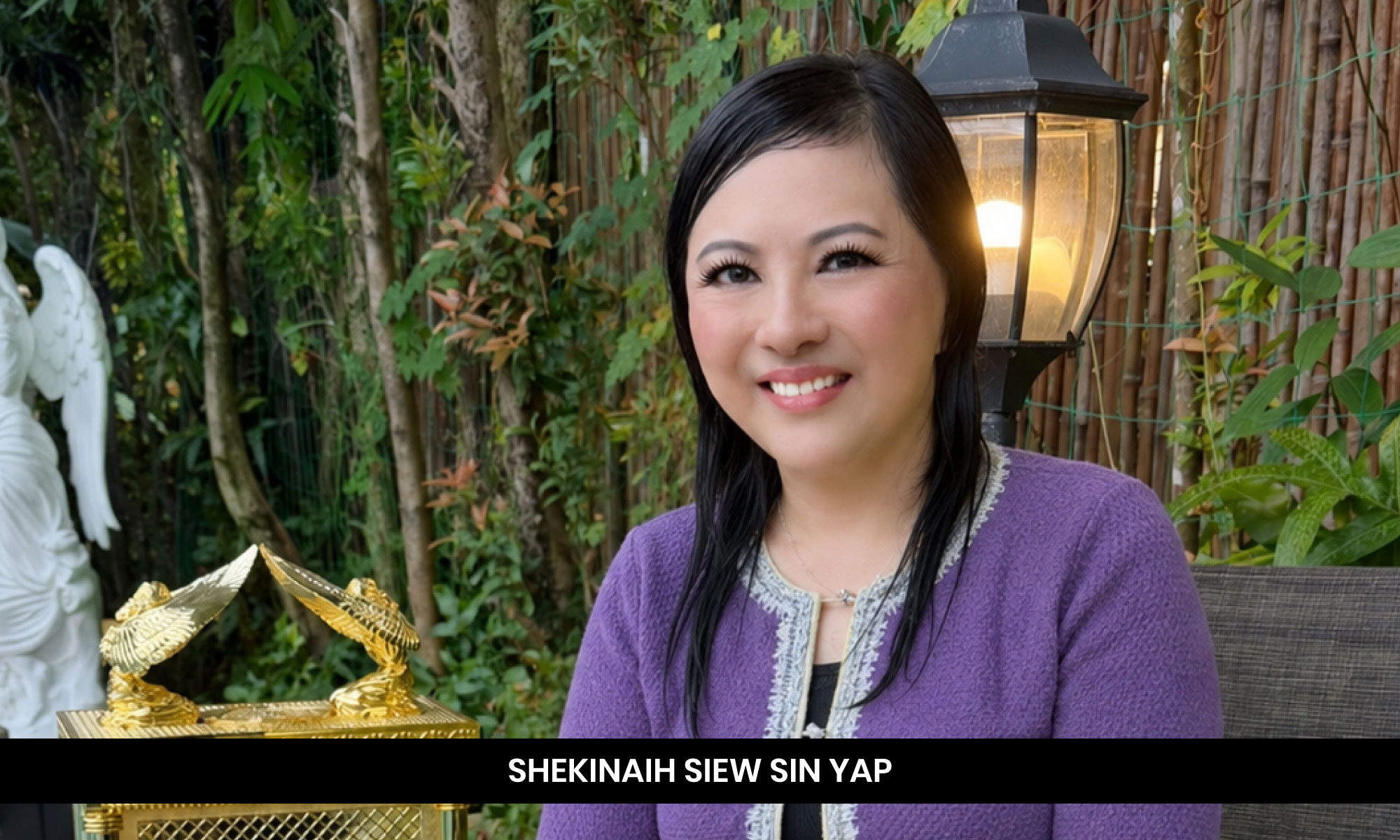
BIBLICAL TRINITY VOICE | SPIRIT OF TRUTH | PROPHETIC JUDGE | DIVINE STRATEGIST | TRINITY AUTHOR & ARTIST | ACTIVATE RESURRECTION POWER | DESTINY IMPARTER | TRAIN 144,000 SPIRIT WARRIOR | GLOBAL DIVINITY | RELIGION | SPIRITUALITY | PEACE AMBASSADOR
FOUNDER & MANAGING PARTNER — CROWNED EAGLES GLOBAL LLP | CE GLOBAL NETWORK LLP
MANAGING DIRECTOR — CROWNED EAGLES GLOBAL GROUP HOLDINGS PTE. LTD. | CE GLOBAL NETWORK INTERNATIONAL PTE. LTD. | CROWNED EAGLES GLOBAL IP HOLDINGS PTE. LTD. | CEG MALAYSIA HOLDINGS SDN. BHD. | CEG PORTFOLIO ABUNDANT SDN. BHD.
EDITORIAL FRAMING: References to divine appearances, revelation, prophecy, healing, resurrection power, the Last Days and other supernatural matters are presented as SHEKINAIH’s personal testimony, faith and interpretation. They are not presented as independently verified scientific, medical or geopolitical conclusions. Appropriate professional medical, legal, financial and other expert care remains fully supported where relevant.
Every meaningful journey begins with a question: what are we willing to become in order to carry what has been entrusted to us? For SHEKINAIH SIEW SIN YAP, that question is inseparable from purpose, obedience, stewardship and restoration.
Her story is not simply about establishing organisations, building networks or navigating entrepreneurship. According to her personal faith testimony, the companies came only after a prolonged process of spiritual preparation that she describes as the Seven Purifications — THE 7 SQUEEZES OF GOD. She says these experiences stripped away self-reliance and prepared her to carry an assignment she did not originate for herself.
She is emphatic about the motive: “I HAD ZERO PERSONAL AMBITION TO ESTABLISH THESE COMPANIES. I STILL HAVE ZERO PERSONAL AMBITION. MY DAILY AIM IS TO DO THE CREATOR’S WILL.” In her account, enterprise was never the destination. It became an instrument placed in her hands for a larger mission.
Behind the growth was something more fundamental: a willingness to listen, respond and serve.
For SHEKINAIH, every problem represents more than an obstacle. It can become an invitation to understand. What caused the difficulty? What needs to be corrected? What has been overlooked? What must be restored? And, perhaps most importantly, how can a difficult circumstance ultimately produce something constructive?
This way of thinking reflects the empathy at the heart of her philosophy. Rather than seeing people merely as customers, partners or stakeholders, she speaks of humanity with a sense of responsibility. Problems are not abstract business cases; they affect real people, families, communities and nations. Solutions, therefore, must carry human meaning.
Her imagination extends beyond conventional definitions of innovation. She describes a desire to pursue what she calls “divine innovation” ideas and possibilities that, in her understanding, originate beyond ordinary human limitations. This conviction has shaped the way she approaches leadership: not simply asking what is commercially possible, but what might become possible when creativity, wisdom and purpose are brought together.
According to her personal testimony, the defining sequence began before the companies existed. She says THE GOD OF THE UNIVERSE first took her through Seven Purifications — THE 7 SQUEEZES OF GOD — to prepare her for the responsibility ahead. Only after that preparation did she receive the instruction to establish CROWNED EAGLES GLOBAL LLP and CE GLOBAL NETWORK LLP. CE Global Network LLP later evolved through restructuring into CE Global Network International Pte. Ltd. For her, this order is essential: preparation before platform, obedience before enterprise, and purpose before growth.
Today, her leadership spans Singapore and Malaysia, with responsibilities across Crowned Eagles Global and the CE Global Network ecosystem. Yet the titles and corporate structures tell only one part of the story. The deeper narrative is about becoming a vessel prepared to serve a purpose.
SHEKINAIH repeatedly returns to the language of restoration. She speaks of moving from limitation into limitless possibility, from earthward thinking into what she describes as heavenward revelation, and from impossibility into divine possibility. These expressions reveal an entrepreneurial worldview in which business is not separated from personal transformation.
In that worldview, leadership begins with the willingness to examine oneself before attempting to change the world. Repentance, for example, is not presented merely as an abstract spiritual concept. She asks what should follow it: correction, responsibility, changed behaviour and tangible fruit. When something has gone wrong, the objective is not simply to identify blame. It is to understand the root cause, undo what must be undone, repair what can be repaired and create conditions for a better outcome.
That approach carries an important lesson for leadership. Restoration requires more than intention. It requires action. It requires the humility to acknowledge what is broken, the empathy to understand who has been affected, the imagination to envision something better, and the courage to take the steps necessary to move toward it. Her greatest joy, she says, is to become a vessel through whom the God of the Universe can flow toward restoration to what she understands as the pre-fall and ultimately perfected state.
Whether one encounters her story through the lens of entrepreneurship, leadership, faith or social impact, its central theme remains consistent: possibility begins when limitation is no longer accepted as the final answer. This is the philosophy behind her aspiration to impart what she believes has been entrusted to her wisdom, understanding, creativity, solutions and the ability to help address challenges facing humanity and nations.
It is also what makes her journey distinctive.
SHEKINAIH is not merely building organisations. She is pursuing a vision of what organisations can become when they are guided by imagination, shaped by empathy and grounded in respect for the people they are intended to serve.
Her story ultimately asks a larger question: What if every challenge contains the possibility of restoration and every limitation is an invitation to imagine something greater?
For SHEKINAIH, the answer is expressed in four movements:
- From Limitation — Into Limitless.
- From Earthward Thinking — Into Heavenward Revelation.
- From Impossibility — Into Divine Possibility.
- From the Grave — Into Resurrection.
And within those words lies the continuing story of a founder who believes that the greatest measure of leadership is not simply what one builds, but what becomes possible for others through what one builds.
Where Discipline Met Compassion, and Faith Became a Way of Leadership
Her journey did not begin with a title, an award, or a magazine cover. It began with discipline, service, and a series of choices that gradually taught her that leadership is not about how high one rises, but about what one carries for others.
Born in Kuala Lumpur, Malaysia, SHEKINAIH later earned a Bachelor of Business Studies in Accounting and Finance from Massey University, New Zealand. Her early professional formation included audit work with Deloitte, followed by approximately six and a half years in financial control and corporate banking at United Overseas Bank (UOB) in Singapore. These experiences trained her to examine facts carefully, understand risk, protect financial integrity, interpret the story behind numbers, and make disciplined decisions.
Yet, the education that most profoundly shaped her heart took place beyond the boardroom. For approximately ten years, she dedicated herself substantially to humanitarian and ministry service, praying for and serving people recovering from drug addiction in a halfway house, people who were blind, persons with intellectual disabilities, elderly residents in care homes, and families carrying burdens that could not be resolved through motivational words alone. One experience became a defining test of her beliefs.
She took responsibility for a fatherless nineteen-year-old young man whose family was experiencing significant hardship. Following what she understood as divine instruction, she paid for his university education, helped his family obtain a home, provided food for them for six years, and, after he graduated in computer science, used her savings to purchase a tuition centre where he could teach, earn an income, and support his family. That act of obedience occurred on the very day her husband was retrenched.
What followed was a six-year period she describes as “closed heaven.” Her husband submitted more than 200 job applications, including applications for positions offering as little as SGD 2,000, yet no offer came. Through that prolonged uncertainty, SHEKINAIH says she continued to trust THE GOD OF THE UNIVERSE to sustain their family.
When their bank balance was approaching zero, she prayed that it was time for Heaven to open. Within approximately two weeks, a headhunter contacted her husband. Although other suitable candidates were available, the headhunter believed the role was meant for him. He ultimately received the position at remuneration equivalent to his previous salary.
For SHEKINAIH, the experience became more than a personal testimony. It became a principle that continues to influence the way she understands adversity, faith and leadership: “Obedience may cost you before it rewards you. Faith may be tested before breakthrough appears. Do not interpret delay as abandonment.” That season forged her worldview.
Accounting taught her accountability. Banking taught her systems. Humanitarian service taught her compassion. Adversity taught her endurance. Faith taught her to look Heavenward when horizontal answers were exhausted. Over time, her understanding of success changed. Life became less about pursuing achievement for its own sake and more about pursuing alignment with purpose. For SHEKINAIH, leadership therefore became something carried rather than something claimed a responsibility to use knowledge, resources, influence and opportunity in ways that can create meaningful change in the lives of others.
When Business Becomes an Instrument of Purpose, Faith, and Humanitarian Transformation
The greatest turning point in SHEKINAIH’s journey did not begin with a business opportunity. According to her personal testimony, it began with preparation. She describes being purified seven times — a process she calls THE 7 SQUEEZES OF GOD — before she was ready to carry the responsibility that followed. Only after those Seven Purifications, she says, did THE GOD OF THE UNIVERSE instruct her to establish CROWNED EAGLES GLOBAL LLP and CE GLOBAL NETWORK LLP. CE Global Network LLP later evolved through restructuring into CE Global Network International Pte. Ltd. She is clear that the sequence matters: purification first, instruction second, enterprise third. “THE COMPANIES DID NOT BEGIN WITH MY AMBITION. THEY BEGAN WITH AN INSTRUCTION. MY RESPONSIBILITY IS TO OBEY, STEWARD AND FULFIL THE PURPOSE FOR WHICH THEY WERE GIVEN.”
From that instruction onward, enterprise became an instrument rather than an identity. Business became an instrument. Capital became an instrument. Leadership became an instrument. Intellectual property became an instrument. Publishing became an instrument. Land became an instrument. Influence became an instrument. Humanitarian service became an instrument. In her words: “ENTERPRISE IS THE INSTRUMENT. THE SEVEN MISSIONS ARE THE REASON.” This perspective shapes the way she approaches strategy, governance and decision-making: discernment before action, purpose before performance, stewardship before ownership and obedience before expansion.
Her philosophy can be distilled into a sequence that reflects the way she approaches purpose:
- PRAY DEEPLY.
Before seeking answers, create space to listen. - DISCERN CAREFULLY.
Not every opportunity is necessarily an assignment, and not every possibility requires pursuit. - VERIFY RESPONSIBLY.
Conviction, in her view, must be accompanied by wisdom, examination and responsible judgment. - STRUCTURE PROPERLY.
Purpose still requires sound systems, governance, resources and execution. - EXECUTE COURAGEOUSLY.
Once the direction is clear, hesitation cannot become an excuse for inaction. - STEWARD FAITHFULLY.
Whatever is entrusted whether resources, influence, knowledge, relationships or opportunity must be handled with responsibility.
At the heart of this philosophy is a belief that alignment precedes achievement.
Before strategy comes surrender.
Before execution comes alignment.
Before breakthrough comes obedience.
For SHEKINAIH, this is not simply a leadership framework. It represents the integration of her professional experience, humanitarian service, entrepreneurial journey and spiritual convictions into a single understanding of purpose. Her story suggests that the most meaningful enterprises may not begin with a market opportunity alone. They may begin with a question of responsibility: What has been entrusted to me, why has it been entrusted to me, and how can I use it to serve something greater than myself? It is through that lens that she continues to view enterprise not merely as something to build, but as something to steward in service of purpose.
The Seven Missions Behind Crowned Eagles Global
For SHEKINAIH, Crowned Eagles Global was not established because she identified an unmet market need or pursued a conventional entrepreneurial ambition. According to her testimony, THE 7 SQUEEZES OF GOD and the Seven Purifications came first. Only after that preparation did THE GOD OF THE UNIVERSE instruct her to establish the organisations. She describes their origin as an assignment carrying Seven Missions through CROWNED EAGLES GLOBAL HEAVEN THRONE ROOM MINISTRY. The business ecosystem therefore exists to serve the mission, not to replace it.
In her understanding, the business ecosystem exists to serve that mission rather than replace it. Enterprise provides the structure and resources; the mission provides the meaning. At the heart of this vision are seven purposes:
1. A Bridge Between Heaven and Earth
The first purpose is to stand as what she describes as a bridge between Heaven and Earth interceding for individuals, families, communities, cities, countries and nations.
For SHEKINAIH, intercession represents an act of responsibility and compassion: carrying the concerns of others before God and seeking what she understands as divine guidance for their circumstances.
2. Bringing Heaven’s Answers to Humanity
The second purpose is to bring what she understands as Heaven’s answers and solutions to humanity.
These concerns extend across individuals and families to businesses, communities, governments and nations. Her vision is rooted in the belief that seemingly complex human challenges can be approached through wisdom, discernment and solutions that transcend conventional thinking.
3. Alerting and Preparing Humanity
The third purpose is centred on warning, preparation and equipping. SHEKINAIH describes a responsibility to alert people to potential dangers, disruptions and circumstances so that they may be avoided, reduced or overcome. Preparation, in this context, becomes an expression of care helping people respond to uncertainty with greater awareness and readiness.
4. Communicating Spiritual Revelation Concerning Leaders and Nations
The fourth purpose concerns what she describes as Heaven’s decrees concerning leaders, nations and world events. She presents these not as conventional political forecasts, but as matters of spiritual revelation and personal faith testimony. The distinction is important to her worldview: the emphasis is on discernment, prayer and spiritual understanding rather than political prediction.
5. Healing, Miracles and Restoration
The fifth purpose is to minister healing, miracles and restoration. Her understanding of restoration extends beyond physical wellbeing. It encompasses the physical, emotional, spiritual, relational and total-life dimensions of a person’s experience. At its heart is empathy the recognition that people often carry wounds and challenges that cannot be understood through a single dimension of life.
6. Addressing Humanity’s Seemingly Unsolvable Problems
The sixth purpose is perhaps the broadest: confronting problems that appear impossible to resolve. These may be personal, spiritual, physical, financial, organisational, governmental, national or international in nature. SHEKINAIH’s approach begins with asking deeper questions: What is the root cause? What needs to change? What must be restored? What steps are required? And how can a negative circumstance ultimately be transformed into a positive outcome?
This reflects her belief that limitations should not automatically be treated as final destinations.
7. Serving as Destiny Impartors
The seventh purpose is what SHEKINAIH describes as serving as destiny imparters. The objective is to help individuals, families, communities, cities and nations discover and fulfil what she describes as their original divine purpose, design and destiny. In this understanding, leadership is not about controlling another person’s journey. It is about helping people recognise their potential, understand their purpose and move toward the possibilities they believe have been placed before them.
Enterprise as an Instrument of Stewardship
These seven purposes explain why SHEKINAIH believes Crowned Eagles Global cannot be reduced to a conventional company description. Enterprise, leadership, publishing, intellectual property, humanitarian initiatives and international business structures are understood as interconnected parts of one larger ecosystem of stewardship.
Each can provide a different means of serving the mission.
Business can create resources.
Leadership can create direction.
Publishing can transmit ideas.
Intellectual property can preserve and extend knowledge.
Humanitarian initiatives can translate compassion into action.
International structures can enable the vision to reach beyond geographical boundaries.
The underlying principle remains consistent: the instrument must never replace the reason for which it exists. For SHEKINAIH, that distinction defines the identity of Crowned Eagles Global.
ENTERPRISE IS THE INSTRUMENT. THE SEVEN MISSIONS ARE THE REASON.
It is a philosophy that places purpose before expansion, stewardship before ownership and service before recognition. In her vision, the measure of an enterprise is therefore not simply how large it becomes, but how faithfully it serves the purpose for which it was established.
Purpose Architecture: Where Enterprise Meets Stewardship
For SHEKINAIH, Crowned Eagles Global represents far more than a conventional business structure. She describes it as a “purpose architecture” a platform where enterprise, stewardship, faith, intellectual strength, humanitarian responsibility, restoration and transformational leadership converge. At the centre of this architecture is a belief that business can carry a responsibility greater than commercial performance. Enterprise can create platforms, resources and opportunities, but its deeper value lies in how those resources are stewarded and what they ultimately make possible for others.
Within her personal Last-Days faith framework, SHEKINAIH describes Crowned Eagles Global as the “Last Days Noah’s Ark” a mission she understands as one of alerting, preparing, restoring, rescuing and preserving humanity in anticipation of what she believes may be significant global disruptions. She also describes its spiritual objective in uncompromising language: “to empty hell and populate Heaven.” This expression reflects the deeply faith-centred foundation from which she understands the organisation’s broader mission.
From Ownership to Stewardship
A central principle in SHEKINAIH’s worldview is the distinction between ownership and stewardship. Money, companies, influence, knowledge, time, relationships, property and opportunity are not viewed merely as possessions. She regards them as things entrusted to individuals and leaders with a corresponding responsibility. The question therefore shifts from:
“I DO NOT REGARD THE COMPANIES, MONEY, INFLUENCE OR OPPORTUNITIES AS THE FINAL PURPOSE. I REGARD THEM AS THINGS ENTRUSTED TO ME. MY DAILY AIM IS TO DO THE CREATOR’S WILL.”
“What do I have?”
to:
“What am I responsible to do with what has been placed in my hands?”
That distinction has significant implications for leadership. Possession can create entitlement; stewardship creates responsibility. It asks leaders to consider not only what they can build, but how their decisions affect people, communities and the future.
Faith Must Become Structure
For SHEKINAIH, spiritual conviction is not an alternative to sound governance. In fact, she believes it should demand greater accountability. Faith, in her philosophy, cannot become an excuse for disorder. Purpose must become structure. Vision must become execution. Compassion must become measurable action. Prayer must be accompanied by responsibility. This principle creates an important bridge between her spiritual worldview and her professional approach. A compelling vision may provide direction, but systems, governance, discipline and execution are required to translate that vision into reality.
Her philosophy can therefore be expressed through a simple progression: Faith → Purpose → Structure → Action → Stewardship → Impact
It is this progression that allows her to view enterprise as more than an economic mechanism. Business becomes a vehicle through which responsibility can be organised, resources can be deployed and long-term objectives can be pursued.
An Architecture Built for the Future
Today, the corporate architecture associated with Crowned Eagles Global includes Crowned Eagles Global LLP and CE Global Network LLP, alongside Crowned Eagles Global Group Holdings Pte. Ltd., CE Global Network International Pte. Ltd., Crowned Eagles Global IP Holdings Pte. Ltd., CEG Malaysia Holdings Sdn. Bhd. and CEG Portfolio Abundant Sdn. Bhd.
Within her broader strategy, SHEKINAIH describes these entities as carrying distinct roles across operations, holdings, intellectual property, international development, land, investment and future resilience. Rather than viewing these structures as isolated companies, she sees them as interconnected components of a wider ecosystem each designed to contribute to a larger architecture of purpose and stewardship.
Ultimately, her vision is built on a fundamental idea: what is built today should be capable of serving tomorrow. That means creating structures that can withstand uncertainty, preserve knowledge, support people, develop opportunities and remain aligned with the purpose that inspired their creation.
For SHEKINAIH, the architecture is therefore not simply corporate. It is purpose made tangible a framework through which faith can inform responsibility, imagination can shape possibility, compassion can become action, and enterprise can serve something larger than itself.
The Discipline of Discernment
For SHEKINAIH, every opportunity must be evaluated against more than its financial potential. She approaches major decisions through a series of filters: purpose, stewardship, integrity, sustainability, strategic alignment, people impact, professional diligence and discernment. An opportunity may appear highly profitable and still be incompatible with the mission. A risk may appear intimidating and yet be necessary to pursue. A deal may look attractive on the surface but carry a hidden cost that is ultimately too high if it compromises integrity.
This distinction is central to her philosophy of leadership: not every profitable opportunity is a purposeful opportunity. SHEKINAIH also draws a clear line between courageous risk and reckless risk. Courage, in her view, does not mean ignoring uncertainty. It means confronting uncertainty with preparation. Before making a significant decision, she believes leaders should understand the numbers, examine the legal implications, consider taxation, review contracts, assess cash flow, understand operational requirements and measure downside exposure. Professional advice should be sought where necessary.
Only after the practical dimensions have been examined does she bring prayer and discernment into the decision-making process. Understand. Examine. Verify. Seek counsel. Pray. Discern. Act. This approach reflects her belief that faith and professional diligence should reinforce rather than contradict one another. Spiritual conviction, in her view, should encourage greater responsibility not less.
Structuring for the Responsibility Ahead
The restructuring of her business interests reflects the same philosophy. As the organisations developed, SHEKINAIH sought structures capable of carrying what she describes as future responsibility. This involved distinguishing operating activities from holding functions and intellectual property, establishing entities across Singapore and Malaysia, and developing an ecosystem capable of supporting multiple areas of long-term development.
These areas include commercial growth, international expansion, land, agriculture, resilience, humanitarian service and long-term mission. For her, corporate structure is therefore not simply an administrative exercise. It is part of stewardship.
The right structure should provide clarity about responsibility, protect valuable assets, support sustainable growth and create the capacity to respond to opportunities and challenges without compromising the underlying mission.
Ultimately, her decision-making philosophy can be distilled into one principle: Growth should never come at the expense of what makes growth worth pursuing.
Profit matters. Strategy matters. Structure matters. Risk matters.
But for SHEKINAIH, integrity is the non-negotiable filter through which all of them must pass.
Discernment Before Decision, Architecture Before Expansion
For SHEKINAIH, every opportunity must be evaluated against more than its financial potential. She approaches significant decisions through a series of filters: purpose, stewardship, integrity, sustainability, strategic alignment, people impact, professional diligence and discernment. These principles reflect her belief that profitability alone cannot determine whether an opportunity is right.
An opportunity may appear highly profitable and still be incompatible with the mission. A risk may appear intimidating and yet be necessary. A deal may look attractive on the surface but carry a hidden cost that is ultimately too high if that cost compromises integrity.
For SHEKINAIH, the question is therefore not simply, “Can this be done?” but also, “Should this be done, and does it align with the responsibility entrusted to us?”
Courageous Risk, Not Reckless Risk
She makes a deliberate distinction between courageous risk and reckless risk. Courage, in her understanding, does not mean ignoring facts. It means having the conviction to act after the facts have been examined carefully.
Her approach begins with diligence:
Understand the numbers.
Understand the law.
Understand taxation.
Understand contracts.
Understand cash flow.
Understand operations.
Understand downside exposure.
Professional advice, where necessary, forms another layer of responsible decision-making. Only after the practical dimensions have been examined does she bring prayer and discernment into the process before deciding whether to proceed. This combination of professional diligence and spiritual discernment forms an important part of her leadership philosophy. Faith, in this framework, does not eliminate due diligence. It strengthens the responsibility to exercise it.
Growth Requires Architecture
The restructuring of the Crowned Eagles Global ecosystem reflects the same philosophy. As the organisations developed, SHEKINAIH sought structures capable of carrying what she believes will be greater future responsibilities. This included separating operating activities, holding functions and intellectual property, establishing entities across Singapore and Malaysia, and developing an organisational platform capable of supporting multiple areas of future activity.
These include commercial growth, international expansion, land, agriculture, resilience, humanitarian service and long-term mission. The objective was not simply to create more entities. It was to create appropriate architecture for an expanding vision. In her view, organisational structure is not an administrative afterthought. It is part of stewardship. A growing enterprise without appropriate governance, clear responsibilities and sustainable structures can eventually become difficult to manage. Growth may create opportunities, but without architecture, those opportunities can also create complexity, duplication and risk.
For SHEKINAIH, the lesson is clear: “GROWTH WITHOUT ARCHITECTURE EVENTUALLY PRODUCES CHAOS. BUILD WHAT CAN CARRY THE FUTURE.”
That principle captures a defining aspect of her approach to leadership. She does not see growth merely as expansion in size or revenue. She sees it as an increasing responsibility requiring stronger foundations. The ultimate objective is therefore not simply to build bigger, but to build better, build responsibly and build structures capable of carrying the weight of the future.
Breaking the Codes of Conventional Leadership
For SHEKINAIH, the future of leadership requires more than new strategies, technologies or business models. It requires challenging the assumptions that have shaped leadership for generations.
- Leadership Equals Power: The first outdated assumption she seeks to challenge is that leadership equals power. In her philosophy, leadership is better understood as stewardship. Authority is not simply a privilege to direct others; it is a responsibility to protect, develop and create value for those entrusted to a leader’s care.
- People Exist to Serve Organisation: The second assumption is that people exist primarily to serve an organisation. She believes the relationship must work both ways. Organisations depend on people to achieve their objectives, but healthy organisations must also develop the people who build them. Growth should therefore be measured not only through revenue, market position or expansion, but also through the capability, confidence and well being of the people within the organisation.
- Profit: The third assumption concerns profit. She does not dismiss profitability. On the contrary, she recognises that profit is essential for sustainability and the ability to continue operating. But she questions the idea that maximum profit should be the ultimate measure of excellence. In her view, profit without purpose can create organisations that are powerful on paper but empty at their core. Sustainable excellence requires a connection between financial performance and a larger sense of responsibility.
- Leadership: The fourth assumption she challenges is that conscience, spirituality and meaning have no place in serious leadership. For SHEKINAIH, leaders are human beings leading human beings. Decisions inevitably carry values, consequences and meaning. Technical competence may determine whether a strategy works, but values influence what leaders choose to pursue in the first place. Identity matters. Conscience matters. Values matter. Rather than treating these dimensions as weaknesses, she views them as part of responsible leadership.
- Hidden Uncertainty: The fifth assumption is that uncertainty must always be hidden. She believes strong leaders do not need to pretend that they possess every answer. Instead, strength can be demonstrated through the humility to acknowledge uncertainty, seek wisdom, consult others and make responsible decisions with the information available. For her, wisdom is not the absence of uncertainty; it is the ability to navigate uncertainty responsibly.
Breaking the Horizontal Mindset
Perhaps the deepest assumption SHEKINAIH wants to challenge is the belief that humanity must look only horizontally for answers. She recognises the extraordinary importance of human achievement. Science matters. Technology matters. Artificial intelligence matters. Medicine matters. Government matters. Capital matters. Universities matter.
These disciplines have transformed civilisation and continue to expand what humanity can accomplish. But she believes there is a danger in becoming so impressed by what humanity can build that people forget to ask where wisdom, meaning and ultimate purpose come from. Her perspective is not about rejecting human knowledge. It is about placing that knowledge within a larger worldview.
Innovation can solve problems.
Technology can extend capability.
Science can reveal how things work.
Capital can create opportunity.
Leadership can mobilise people.
But, in her philosophy, none of these should replace the search for wisdom and purpose. This is why her approach to leadership ultimately extends beyond conventional definitions of performance. She wants leaders to remain intellectually ambitious while also being humble enough to recognise the limits of human understanding.
Her leadership philosophy can therefore be expressed in four imperatives:
BUILD INTELLIGENTLY.
LEAD EXCELLENTLY.
INNOVATE COURAGEOUSLY.
BUT LOOK HEAVENWARD.
For SHEKINAIH, looking Heavenward does not mean looking away from the world. It means engaging with the world with greater responsibility, imagination, empathy and humility while remaining conscious that leadership is ultimately about more than what humanity can build. It is about what humanity chooses to build, why it builds it, and whom that creation is ultimately intended to serve.
Purpose and Stewardship: The Measure Beyond Revenue
For SHEKINAIH, two questions sit at the heart of responsible leadership:
Purpose asks: “Why does this exist?”
Stewardship asks: “How faithfully am I managing what has been entrusted to me?”
She believes neither question is complete on its own. Purpose without stewardship can become rhetoric a powerful vision that never becomes responsible action. Stewardship without purpose can become administration efficient management without a meaningful destination.
The real power lies in bringing the two together.
Growth as Capacity for Impact
For SHEKINAIH, commercial growth should do more than increase financial performance. It should expand an organisation’s capacity for impact. As companies grow, governance should become stronger. People should develop alongside the organisation. Intellectual property should be protected. Social impact should deepen. Resilience should increase. Preparation should become increasingly practical.
Growth, therefore, carries an accompanying responsibility.
An organisation should become capable of carrying more responsibility, rather than simply accumulating more revenue. This perspective changes how growth is measured. Revenue remains important because financial sustainability provides the resources required to continue operating and expanding. But revenue is not the final destination. Its greater significance lies in what it makes possible.
Money as an Amplifier
SHEKINAIH views money not as the destination, but as an amplifier.
In the hands of fear, it can amplify fear.
In the hands of ego, it can amplify ego.
In the hands of purpose, it can amplify purpose.
The implication is profound: financial resources do not automatically create meaningful outcomes. Their impact depends upon the values, structures and intentions guiding their use.
Capital can fund innovation.
It can develop people.
It can protect intellectual property.
It can strengthen resilience.
It can support humanitarian initiatives.
It can create opportunities.
It can help transform ideas into institutions capable of serving others.
The question, therefore, is not merely how much an organisation earns. It is what its earning capacity enables it to build, protect, create, develop, restore and fulfil.
A Different Definition of Success
This philosophy offers a broader definition of organisational success. A successful organisation is not simply one that becomes larger. It is one that becomes more capable, more responsible and more purposeful as it grows.
Growth should strengthen foundations rather than weaken them. Expansion should increase accountability rather than diminish it. Wealth should increase capacity for service rather than become an end in itself.
For SHEKINAIH, this is where purpose and stewardship meet: purpose provides the direction; stewardship determines the quality of the journey.
Her principle is therefore simple: “DO NOT ASK ONLY WHAT THE ORGANISATION EARNS. ASK WHAT ITS EARNING CAPACITY ENABLES IT TO BUILD, PROTECT, CREATE, DEVELOP, RESTORE AND FULFIL.”
In that question lies a different way of thinking about enterprise one in which financial performance is not the conclusion of the story, but the beginning of what greater responsibility and greater impact might make possible.
Divine Innovation: Beyond the Limits of What Is Already Known
For SHEKINAIH, innovation begins with courage the courage to question assumptions, challenge established limitations and search for possibilities beyond what is already understood. Technology is one expression of innovation, but she believes innovation extends far beyond technology. It can involve rethinking organisational structures, leadership, ownership, land use, humanitarian response, publishing, intellectual property, preparedness and even the way commerce can serve a larger purpose.
At the deepest level of her philosophy is what she describes as “divine innovation” wisdom and solutions that she believes originate Heavenward and may surpass the boundaries of current earthly understanding.
She describes this pursuit through a continuing prayer: “I ALWAYS PRAY FOR THE GOD OF THE UNIVERSE TO IMPART WISDOM, UNDERSTANDING AND DIVINE IMPARTATION TO RESTORE MANKIND FROM LIMITATION INTO LIMITLESS POSSIBILITY IN EVERY SPHERE OF LIFE.”
For SHEKINAIH, this is not a rejection of human knowledge. Rather, it is an invitation to remain humble about its boundaries. The question is not simply whether humanity has already discovered the best answer. It is whether there may be another answer that has not yet been perceived.
That mindset changes the role of a leader. Instead of assuming that existing knowledge represents the final boundary of possibility, leaders can remain curious enough to ask different questions, humble enough to acknowledge what they do not know, and courageous enough to explore what may initially appear impossible.
The End of Self and the Beginning of Enablement
This philosophy also connects with SHEKINAIH’s five-volume BEHOLD MY MESSENGER series. Within this body of teaching, she presents a spiritual architecture centred on surrender, alignment, obedience, divine enablement, transformation and fulfilment of purpose. She describes this framework as the “THE 7 SQUEEZES OF GOD.”
At its heart is a paradox: “THE END OF SELF IS NOT THE END OF CAPACITY. IT IS THE BEGINNING OF DIVINE ENABLEMENT.”
For her, surrender is therefore not synonymous with passivity. It represents a transition from relying exclusively on personal capacity toward what she understands as divine enablement.
From Symptom to Wholeness
In BEHOLD MY MESSENGER 5: BEHOLD THE RESURRECTION OF THE DEAD, SHEKINAIH presents what she calls “THE 50 PROTOCOLS OF HEAVEN.”
Within her faith framework, she teaches that these correspond spiritually to 50 acupuncture points of the human body and describe a journey that moves beyond visible symptoms toward deeper causes and restoration.
The sequence is expressed as: SYMPTOM → ROOT CAUSE → UPROOTING → OBEDIENCE → PRAYER → HEALING LIGHT → RESTORATION → WHOLENESS
The underlying idea is one of moving from surface-level observation toward deeper understanding. Rather than stopping at the visible problem, the framework asks what lies beneath it, what needs to change, and what steps may contribute to restoration. Importantly, SHEKINAIH explicitly advocates the use of appropriate professional healthcare alongside her spiritual framework.
Use doctors.
Use hospitals.
Use medicine.
Use science.
Use rehabilitation.
Use preventive care.
Use professional expertise.
For her, faith and professional expertise do not need to be positioned as opposing forces. Instead, she believes human knowledge and professional care should be used responsibly while maintaining openness to possibilities beyond what is currently understood. This balance captures the broader philosophy behind her approach to innovation.
Innovation requires intelligence.
Innovation requires humility.
Innovation requires imagination.
Innovation requires courage.
And in SHEKINAIH’s worldview, the greatest innovation may emerge when human capability remains open to wisdom she believes comes from beyond human capability. The objective is ultimately the same one that runs through her wider mission: From limitation into limitless possibility.
A Heavenward Culture: Developing People Beyond Dependency
For SHEKINAIH, the culture she seeks to build is not centred on creating dependence upon a human personality. Instead, she describes her leadership philosophy as one that directs people Heavenward, back toward their Creator, THE GOD OF THE UNIVERSE. Her aspiration is for people to experience what she understands as restoration to their perfected state and to discover and fulfil the mission and destiny given to them by their Creator.
At the centre of this philosophy is a deeply held belief that the capacities required for transformation destiny, breakthrough, enablement, gifting, wisdom and solutions to humanity’s challenges are ultimately derived from what she understands as divine impartation. She expresses this conviction through the belief that:
“ALL THE DESTINY, BREAKTHROUGH, ENABLEMENT, GIFTING AND ANSWERS TO SOLVE PROBLEMS OF HUMANITY AND NATIONS, I BELIEVE, HAVE BEEN IMPARTED OR DOWNLOADED FROM THE GOD OF THE UNIVERSE INTO ME SO THAT I MAY IMPART THEM INTO HUMANITY, NATIONS AND COUNTRY LEADERS.”
Leadership as Impartation
For SHEKINAIH, leadership therefore extends beyond transferring information or professional knowledge. She describes it as impartation the transmission of what she understands as destiny, wisdom, courage, breakthrough, enablement, restoration and divine strategy. This creates a different understanding of the leader’s responsibility. The objective is not to create followers who remain dependent upon the leader. Instead, the leader’s role is to help people recognise and develop what she believes has already been placed within them.
Her aspiration is to see people stop living beneath what she understands as their Creator-designed capacity. In this sense, leadership becomes developmental rather than possessive. Its success is reflected not in how many people remain attached to a leader, but in how many people become capable of walking confidently in their own purpose.
Restoring the Person Behind the Potential
SHEKINAIH’s vision extends beyond professional development. Her goal is to develop people who become followers of THE GOD OF THE UNIVERSE, reunited with their Creator, restored toward what she understands as their perfected state, and increasingly formed in what she describes as the Creator’s character and divine nature.
This makes restoration an important dimension of her leadership philosophy. People are not viewed simply through their professional titles, economic contribution or measurable achievements. They are understood as individuals carrying potential, purpose, experiences, responsibilities and what she believes is a divinely designed destiny.
The task is therefore not merely to ask how much someone can achieve. It is to ask what they were created to become.
From Achievement to Purpose
The culture SHEKINAIH seeks to cultivate can therefore be described as Heavenward, destiny-centred and restorative. It moves the conversation from achievement toward purpose.
Instead of asking only: “What can I achieve?”
it invites deeper questions:
“Why was I created?”
“What was placed within me?”
“What am I responsible for?”
“How do I fulfil the Heaven blueprint for my life?”
These questions reflect her belief that human potential should not be measured solely by conventional definitions of success.
A career can be successful and still lack purpose. An organisation can be profitable and still lack meaning. A person can be influential and still remain disconnected from who they were created to become.
For SHEKINAIH, genuine transformation occurs when capacity, character and purpose begin moving in the same direction. Ultimately, the culture she envisions is not about building a personality cult or creating permanent dependence. It is about helping people look beyond the individual leader toward what she understands as their ultimate source of identity, purpose and possibility.
The leader may impart.
The organisation may equip.
The community may support.
But the destination remains Heavenward.
That is the culture SHEKINAIH seeks to build: one in which people are not merely developed to perform better, but encouraged to discover why they exist, what they carry, whom they are called to serve, and how they can fulfil the purpose they believe their Creator has placed within them.
Leadership Under Pressure: Finding the Root and Restoring the System
For SHEKINAIH, challenges are not merely obstacles to overcome; they are moments that reveal the character of leadership.
When resources become constrained, what happens to integrity?
When a carefully developed plan fails, what happens to courage?
When people disappoint, what happens to compassion?
And when the future becomes uncertain, does a leader still have the conviction to take the next right step?
These questions shape the way SHEKINAIH approaches adversity.
Rather than simply suppressing visible symptoms, she believes in searching for the root cause. Her approach begins with a series of questions:
What caused this?
What must be corrected?
What needs to be undone?
What steps must be taken?
Where is repentance required?
What fruit should follow repentance?
How can the negative be overturned into the positive?
“I WILL NOT DO ANYTHING WITHOUT FIRST ASKING THE GOD OF THE UNIVERSE, WHOM I TESTIFY STANDS BEFORE ME AND INSTRUCTS ME. I ASK FOR THE ROOT CAUSE OF EVERY PROBLEM OR CHALLENGE, HOW TO UNDO OR RESOLVE IT, WHAT STEPS ARE REQUIRED, WHAT FRUIT MUST MATCH REPENTANCE WHERE DISOBEDIENCE HAS CAUSED BACKLASH, AND HOW EVERY NEGATIVE EVENT CAN BE OVERTURNED INTO A POSITIVE OUTCOME.”
For SHEKINAIH, this process is both spiritual and practical. She states that she seeks the guidance of THE GOD OF THE UNIVERSE before making significant decisions, asking for understanding of the root cause behind a problem, the steps required to resolve it, and the transformation necessary when she believes disobedience has produced negative consequences.
This perspective has become a defining part of her approach to adversity: do not merely manage the symptom; understand what created it.
The Root-Cause Mindset
The same principle extends into her approach to business and organisational leadership. A cash-flow problem may appear financial on the surface while having a deeper strategic cause. A culture problem may appear to be a people issue while having an underlying integrity problem. A recurring people conflict may originate from poor communication. A repeated organisational failure may be the consequence of an assumption that nobody has stopped to question.
In each case, treating only the visible symptom may provide temporary relief without creating lasting transformation. The deeper task is to identify what is underneath. This philosophy also connects with the 50 Protocols teaching within her wider body of work, where she emphasises moving from symptom toward root cause, followed by what she describes as uprooting, obedience, prayer, healing, restoration and wholeness. Applied to leadership, the principle becomes remarkably practical:
Find the root.
Understand the root.
Confront the root.
Correct what is misaligned.
Create the conditions for different fruit.
From Crisis to Transformation
SHEKINAIH’s objective is not simply to survive difficult circumstances. It is to use adversity as an opportunity for correction and transformation.
A negative event can become a lesson.
A failure can expose an assumption.
A conflict can reveal a communication gap.
A financial challenge can expose structural weakness.
A disappointment can test and potentially deepen compassion.
This does not mean that every negative circumstance is immediately transformed into something positive. Rather, it reflects her conviction that the response to adversity can determine what eventually grows from it. The leader’s responsibility is therefore to remain willing to examine the situation honestly, seek wisdom, make corrections and act with courage.
For SHEKINAIH, restoration is a process rather than a slogan.
It requires identifying what went wrong, taking responsibility where necessary, correcting alignment, implementing practical steps and demonstrating through action that change has occurred. Her philosophy can ultimately be distilled into seven movements:
FIND THE ROOT.
UPROOT THE ROOT.
CORRECT THE ALIGNMENT.
PRODUCE THE FRUIT.
RESTORE THE SYSTEM.
STRENGTHEN WHAT WAS WEAK.
TURN THE NEGATIVE INTO THE POSITIVE.
It is a model of leadership that treats challenges not merely as threats to be contained, but as opportunities to discover what needs to change and then to have the courage to change it.
Recognition, Responsibility and the Evidence of Purpose
For SHEKINAIH, recognition is meaningful, but it is never intended to become the destination. She regards every award, distinction and public platform as an opportunity to extend a larger purpose. “I am grateful for recognition, but I never want the trophy to become greater than the purpose behind it.”
In her philosophy, awards are platforms. Platforms create influence, and influence creates responsibility. Recognition therefore carries an obligation to ensure that visibility is translated into meaningful contribution.
Recognition as Responsibility
Her selected personal and international recognitions include:
- The Most Influential Personality to Follow in 2026
- Global Women of Influence Awards 2026 — Winner
- Certificate of Honor and Distinguished Emblem for Positive Social Development — UNPKFC, Bangkok, 2025
- Global Leadership Achievement Award — Bangkok, 2025
- Divine Restoration Ignition Award — Los Angeles, 2025
- MegaSuccess Los Angeles Recognition — 2025, including recognition alongside J AARON K DAVID as authors and founders of a multimillion-dollar enterprise
- Certificate of Excellency — Global Divinity Ambassador — Mumbai, 2026
- IISA International Delegate Recognition — Muscat
- BCI Recognition — Muscat
- 75 Years of Peace Recognition — Kolkata
- Walk for Peace Recognition — Kolkata
- Sister Nivedita University Recognition — Kolkata
- Commemorative audience/engagement associated with His Holiness the 14th Dalai Lama
Her corporate journey has also received recognition, including:
- CE GLOBAL NETWORK (INTERNATIONAL) — Singapore SME 500 Award Winner 2026
- CE GLOBAL NETWORK (INTERNATIONAL) — Dun & Bradstreet Business Eminence Awards 2026, Silver Category
For SHEKINAIH, these corporate recognitions represent an important principle: purpose does not have to come at the expense of performance. Faith, in her understanding, does not eliminate accountability. Spiritual conviction does not replace professional discipline. Instead, stewardship demands excellence.
When Crisis Became an Opportunity
The business journey itself contains one of the experiences she regards as a significant testimony. During the COVID-19 pandemic, borders were closing, supply chains were disrupted and freight markets were experiencing extraordinary volatility. Yet, during this period, the logistics business accelerated. Customers arrived with urgent requirements. Problems needed immediate solutions. Decisions had to be made quickly. The enterprise grew substantially without conventional advertising. She views that period as evidence that several forces can operate together rather than in opposition:
Prayer.
Professional competence.
Disciplined cash-flow management.
Timely action.
Practical problem-solving.
For her, faith did not mean waiting passively for circumstances to change. It meant combining spiritual conviction with professional responsibility and decisive execution.
Faith Testimony and Public Declarations
Her public ministry testimony also includes declarations she says were made before major political outcomes involving Donald Trump serving two terms as President of the United States, Anwar Ibrahim becoming Prime Minister of Malaysia, Lawrence Wong becoming Prime Minister of Singapore, and Tharman Shanmugaratnam becoming President of Singapore.
She also describes a ministry testimony concerning Cape Town’s feared “Day Zero” water crisis, during which she says she prayed and decreed for rain. According to her testimony, rain subsequently continued for approximately six months and reservoirs were replenished. She presents these accounts specifically as faith testimony concerning what she understands as the activity of THE GOD OF THE UNIVERSE, rather than as conventional political forecasting or scientific prediction.
This distinction is central to how she wants such experiences understood: as expressions of personal faith and spiritual conviction rather than claims of conventional predictive expertise.
Warning Must Become Preparation
Across both her business and ministry narratives, a common principle emerges: recognition, revelation and warning have value only when they lead to responsible action. A warning that produces no preparation changes nothing. An opportunity that produces no execution creates nothing. A vision without structure remains an idea. And recognition without responsibility becomes merely a trophy.
For SHEKINAIH, the deeper purpose is therefore not to accumulate distinctions, but to use every platform responsibly to strengthen the work, serve people, develop organisations and advance what she understands as her larger mission.
Her philosophy can be expressed simply: “GOD WARNS AHEAD BECAUSE GOD SEES AHEAD. A WARNING WITHOUT ACTION CHANGES NOTHING.”
In that statement lies the connection between her faith and her leadership: to see, to discern, to prepare and then to act.
Humanitarian Service: The Measure of a Life Restored
For SHEKINAIH, humanitarian service was never designed as a public-relations category. It existed long before awards, recognition or public visibility. Her understanding of service was formed through direct encounters with people whose circumstances demanded more than words. Her earlier years included serving people recovering from drug addiction, people who were blind, persons with intellectual disabilities, elderly people, distressed families and young people requiring sustained practical support.
Those experiences shaped a fundamental conviction: sometimes, people do not need another motivational quotation. They need something tangible.
They may need tuition fees.
They may need a meal.
They may need accommodation.
They may need someone to sit beside them.
They may simply need someone to believe that their present circumstances are not their final identity.
For SHEKINAIH, empathy becomes meaningful when it moves beyond feeling and becomes action.
Beyond Charity: Toward Restoration
Her understanding of humanitarian service is closely connected to her broader philosophy of restoration. She believes that the deepest form of service is not merely helping someone survive a difficult season, but helping them move toward what she understands as their Creator-given purpose.
She expresses this conviction through a deeply personal belief: “WHEN A PERSON DOES THE WILL OF THE CREATOR FOR THEIR LIFE, IS RESTORED TO THEIR PERFECTED STATE AND LINKED BACK TO THEIR CREATOR, IT GIVES ME JOY UNSPEAKABLE THAT NO AMOUNT OF MONEY OR MATERIAL THINGS CAN SATISFY.”
For her, the restoration of a human life can represent a greater reward than financial success.
A person who once felt forgotten begins to hope.
A young person receives an opportunity to study.
A struggling family gains stability.
Someone discovers the courage to begin again.
A life that appeared limited begins to reveal possibility.
These are outcomes that cannot always be captured on a balance sheet, yet SHEKINAIH considers them among the most meaningful measures of impact.
A Father’s Heart Toward Creation
She describes her heart toward humanity through the imagery of a father’s heart toward his children a perspective rooted in compassion, protection, responsibility and restoration. Within her spiritual worldview, this concern extends beyond individual circumstances toward humanity as a whole and even toward what she describes as alien or other created beings.
At the centre of this worldview is her desire to become a vessel through whom THE GOD OF THE UNIVERSE can bring restoration toward what she understands as the pre-fall and ultimately perfected state. This gives her humanitarian philosophy a broader dimension. Service is not simply about solving an immediate problem. It is about asking what would allow a person, family or community to move toward greater wholeness.
The Return That Cannot Be Measured
For SHEKINAIH, service challenges conventional ideas about return on investment. Business naturally asks about financial return. Humanitarian service asks a different question: What changed because we were there?
Sometimes the answer may be measurable in resources provided, education enabled or material needs addressed. At other times, the impact is deeply personal and difficult to quantify. The greatest return may be:
A life restored.
A family strengthened.
A destiny awakened.
A person who begins to hope again.
This is why humanitarian responsibility remains central to her understanding of leadership. She does not see service as something added to an otherwise successful career. She sees it as part of the foundation upon which her definition of success was formed. For her, true abundance is not simply having more to give.
It is becoming capable of giving what another person genuinely needs and doing so with dignity, empathy and respect. Ultimately, her philosophy of service can be distilled into one belief: The greatest measure of what we possess is not what we keep, but what we can responsibly use to restore another life.
Redefining Success: Beyond Wealth, Recognition and Achievement
For SHEKINAIH, success cannot be measured solely through wealth, influence, awards or corporate growth. She acknowledges the importance of revenue, sustainability, profitability and achievement, but believes these are indicators of performance not the ultimate definition of a successful life. Her deeper definition of success is rooted in what she describes as a personal spiritual testimony.
According to her testimony, she saw THE GOD OF THE UNIVERSE write the meaning of SUCCESS upon a whiteboard in Heaven. She preserves the meaning as follows:
S — SUBMIT
U — UNCONDITIONALLY REGARDLESS OF ANY
C — CIRCUMSTANCES BECAUSE THE
C — CALLING IN EACH OF US, HUMANITY, SHALL
E — EMERGE VICTORIOUS BECAUSE, WE ARE
S — SYNCHRONIZING WITH ALIGNMENT WITH HEAVEN’S PATH OF ULTIMATE
S — SUCCESS INDEFINITELY!!!
For SHEKINAIH, these words represent a radically different understanding of achievement. Success is not simply about reaching a destination that society has defined. It is about alignment, submission, calling, perseverance and purpose the process of synchronising one’s life with what she understands as Heaven’s path.
When Achievement Is Not Enough
A person may accumulate wealth and still feel that something essential is missing. They may build influential companies, receive prestigious awards, gain public recognition and achieve extraordinary financial success, yet never ask the deeper question: “Was this actually the purpose for which I was created?”
For SHEKINAIH, that question changes the entire definition of achievement.
A successful career is valuable.
A successful enterprise is valuable.
Financial independence is valuable.
Recognition can be meaningful.
But none of these, in isolation, establishes that a life has fulfilled its ultimate assignment. She believes that a person of modest means who faithfully walks in what they understand as their God-given destiny may be more successful than someone who possesses billions but has moved far away from their purpose.
Success as Alignment
Her philosophy places alignment before accumulation. The central question becomes not merely: “How much have I achieved?”
but: “Am I aligned with what I was created to fulfil?”
This understanding also explains why submission occupies the first position in her definition of SUCCESS. Submission, as she understands it, is not weakness or the surrender of ambition. It is the willingness to place personal ambition beneath a greater calling.
It means allowing purpose to determine direction. It means continuing through circumstances that test conviction. It means trusting that victory is not always defined by immediate results. And it means measuring the journey by faithfulness to the assignment rather than simply by the applause that follows achievement.
The Assignment Beyond the Applause
This perspective brings her philosophy of leadership, business and humanitarian service into a single framework.
Enterprise becomes a vehicle.
Wealth becomes a resource.
Influence becomes a responsibility.
Knowledge becomes something to steward.
Recognition becomes a platform.
Leadership becomes service.
The common question is always: What is this ultimately for?
For SHEKINAIH, the answer lies in fulfilling purpose.
Her definition of success therefore moves beyond conventional measures of status and accomplishment toward something she describes as Heavenward synchronization — a life increasingly aligned with calling, responsibility and destiny. Ultimately, her philosophy can be captured in one uncompromising statement:
“SUCCESS WITHOUT DESTINY IS STILL FAILURE IF THE ASSIGNMENT WAS NEVER FULFILLED.”
For her, the greatest achievement is therefore not simply to build something impressive, but to reach the end of one’s journey knowing that the life, resources, opportunities and responsibilities entrusted to that person were used in alignment with the purpose they were created to fulfil.
Preparing Before the Storm: A Vision for Resilience and Preservation
For SHEKINAIH, the future cannot be defined solely through conventional five-year plans, revenue targets or corporate expansion. Her long-term objectives are rooted in a broader faith framework in which she describes Crowned Eagles Global as “THE LAST DAYS NOAH’S ARK” a mission centred on warning, preparation, healing, restoration, destiny, resilience and the preservation of humanity.
At the heart of this vision is her belief that humanity can be prepared for significant challenges before those challenges fully emerge. She envisions a future in which people are helped to move toward what she understands as their perfected state, reconnect with their Creator and discover the unique destiny, enablements and giftings she believes have been placed within them.
For her, the objective is not simply to prepare organisations for disruption. It is to prepare people, communities and systems to remain resilient when disruption occurs.
A Revelation She Holds as Personal Faith
As part of her personal testimony, SHEKINAIH says that THE GOD OF THE UNIVERSE revealed to her that the Earth has less than 40 years before destruction by fire. She presents this explicitly as a claimed spiritual revelation and Last-Days interpretation, rather than an independently verified scientific forecast. She has also described visions concerning what she calls World Wars 3 and 4, including scenarios involving nuclear conflict, abnormal weather phenomena and severe famine. These, too, are presented by her as personal visions and faith claims, not independently verified geopolitical predictions. Regardless of how these beliefs are interpreted, they create a practical sense of urgency within her mission.
The question becomes: If severe disruption were to occur, would humanity be prepared?
From Revelation to Resilience
This question translates her spiritual convictions into practical areas of preparation. She places particular emphasis on:
Food security.
Water security.
Land.
Agriculture.
Shelter.
Community resilience.
Training.
Humanitarian preparedness.
Physical infrastructure.
Her vision includes developing places around the world that she compares to Goshen in the Biblical account — places where food, water, shelter and practical resources could be preserved and communities could remain capable of supporting one another during periods of severe disruption.
The emphasis is therefore not simply on predicting catastrophe. It is on building resilience before catastrophe.
The Ark Must Be Built Before the Flood
The ancient story of Noah provides the central metaphor for her approach. The Ark was built before the flood. That becomes the principle she wants to apply to the modern world: Do not wait for systems to fail before building resilience. Strengthen food and water security before shortages emerge. Prepare people before emergencies occur. Develop communities capable of helping one another before isolation becomes unavoidable. Build infrastructure before infrastructure becomes vulnerable. Develop knowledge, skills and resources before they are urgently needed. For SHEKINAIH, preparation is therefore an expression of responsibility rather than fear. It represents the belief that foresight should lead to constructive action.
Preserving Humanity
Her ambition extends beyond the corporate entities she leads. She describes her larger responsibility in expansive terms: “I AM CALLED TO PRESERVE MANKIND AT LARGE.”
This statement captures the scale of the future she imagines. The objective is not merely to preserve assets or businesses. It is to create systems capable of preserving human life, dignity, knowledge, resources, community and possibility through periods of uncertainty. In this vision, spiritual preparation and practical preparation are interconnected.
People need wisdom.
They need skills.
They need food and water.
They need shelter.
They need community.
They need resilient infrastructure.
They need hope.
They need purpose.
The future architecture she imagines therefore seeks to bring these dimensions together.
Preparing Before the Crisis Becomes Visible
For SHEKINAIH, the greatest lesson of the Ark is ultimately about timing. Preparation delayed until the crisis arrives may be preparation that came too late. Her philosophy is therefore built around proactive responsibility: identify vulnerabilities, build capacity, strengthen systems, develop people and establish resources while there is still time to do so.
The vision is not simply about surviving what may come. It is about creating conditions in which people can continue to serve, protect, rebuild and restore even when surrounding systems are under pressure. Her future mission can ultimately be expressed through four imperatives:
SEEK NOW.
PREPARE NOW.
OBEY NOW.
FULFIL DESTINY NOW.
For SHEKINAIH, the Ark is therefore more than a Biblical image. It represents a philosophy of leadership and preparedness:
Build before the storm.
Strengthen before the crisis.
Serve before you are needed.
Prepare before the warning becomes visible.
And above all, build an architecture capable of carrying humanity through uncertainty toward restoration and a future of possibility.
Looking Heavenward: A Leadership Philosophy for the Next Generation
For SHEKINAIH, leadership is ultimately about changing the direction of humanity’s gaze. She hopes her work will encourage people to rediscover where they can look when human systems reach their limits. She wants entrepreneurs to build, innovators to create, investors to multiply, leaders to lead and humanitarians to serve—but, above all, she wants them to remember what she understands as their ultimate Creator.
Her aspiration is expressed in a simple but powerful conviction:
“I HOPE MY LEADERSHIP WILL REVOLUTIONIZE MANKIND TO LOOK HEAVENWARD FOR ANSWERS FOR THEIR LIVES, THEIR COUNTRIES, THEIR FAMILIES AND THEIR ALL-IN-ALL.”
This belief is rooted in her understanding of THE GOD OF THE UNIVERSE as a Creator who loves humanity with the care of a Father toward His sons and daughters.
A Message to the Next Generation
Her message to the next generation begins with purpose. She encourages young people to seek what she calls the Heaven blueprint for their lives and to approach the challenges they encounter not merely as obstacles, but as opportunities for formation. Within her faith framework, she encourages people to meet testing with gratitude rather than bitterness, to respond positively to adversity and to remain open to the possibility that difficult seasons can develop character and prepare a person for destiny.
She believes that what appears to be a setback may sometimes become part of a larger process of preparation. In this worldview, testing is not simply something to endure. It can become something through which a person discovers resilience, maturity, faith and purpose.
When Something Appears Finished
This conviction is central to her five-volume BEHOLD MY MESSENGER series, particularly BEHOLD MY MESSENGER 5: BEHOLD THE RESURRECTION OF THE DEAD. For SHEKINAIH, resurrection represents the possibility that something declared finished may not actually be finished.
A dream may appear dead.
A business may appear dead.
A destiny may appear dead.
Hope may appear dead.
But she challenges people not to write the final sentence before what they understand as the Creator has spoken. Her message is therefore not limited to physical resurrection. It extends metaphorically and spiritually toward the resurrection of hope, purpose, destiny, vision, families, enterprises and nations. Within the testimonies associated with her ministry and writings, she shares accounts that she understands as expressions of restoration and resurrection power. She presents these as faith testimonies rather than substitutes for professional medical evidence or appropriate care. The deeper purpose, in her view, is to encourage people to recognise that what humanity calls “the end” may not necessarily be the final chapter.
The Mega Declaration
Her philosophy culminates in what she describes as a Final Mega Declaration to Humanity. She does not reject human capability. On the contrary, she acknowledges the extraordinary resources humanity has developed:
Science.
Medicine.
Technology.
Artificial intelligence.
Government.
Corporations.
Universities.
Capital.
Education.
Professional expertise.
Her instruction is to use them responsibly. Use medicine. Use doctors. Use technology. Use science. Use advisers. Use law. Use education. Use finance. Use human wisdom.
But, in her worldview: “BUT DO NOT STOP THERE.”
When human intelligence reaches what she perceives as its ceiling, she calls people to look beyond that ceiling.
WHEN STRATEGY FAILS — LOOK UP.
WHEN EVERY DOOR APPEARS CLOSED — LOOK UP.
WHEN THE PROBLEM APPEARS IMPOSSIBLE — LOOK UP.
WHEN THE BOARDROOM HAS NO ANSWER — LOOK UP.
WHEN THE NATION HAS NO ANSWER — LOOK UP.
WHEN HUMANITY HAS NO ANSWER — LOOK UP.
For SHEKINAIH, looking Heavenward does not mean abandoning human intelligence. It means combining human responsibility with what she understands as divine wisdom.
Instruction Must Become Action
Her philosophy ultimately follows a sequence: INSTRUCTION → OBEDIENCE → ACTION → BREAKTHROUGH
The sequence reflects her conviction that receiving what she understands as divine direction is only the beginning. Instruction must be followed by obedience, obedience by action, and action by the possibility of breakthrough. This principle also connects with her wider leadership philosophy.
Knowledge has value.
Strategy has value.
Innovation has value.
Resources have value.
But their greatest potential is realised when they are aligned with purpose. She therefore sees adversity differently from conventional definitions of failure. When knowledge reaches its limit, possibility may begin. When destiny appears delayed, preparation may be taking place. When adversity strikes, purpose can still prevail. When impossibility stands before humanity, possibility may still emerge. And when the world sees a grave, she believes Heaven may see a beginning.
From Limitation to Limitless
Everything returns to the central language of her philosophy:
FROM LIMITATION — INTO LIMITLESS.
FROM EARTHWARD THINKING — INTO HEAVENWARD REVELATION.
FROM IMPOSSIBILITY — INTO DIVINE POSSIBILITY.
FROM THE GRAVE — INTO RESURRECTION.
Her invitation to humanity is therefore expansive:
LOOK HEAVENWARD.
SEEK YOUR CREATOR.
RECEIVE YOUR HEAVEN BLUEPRINT.
RECEIVE YOUR DESTINY.
RECEIVE DIVINE WISDOM.
RECEIVE DIVINE STRATEGY.
RECEIVE DIVINE INNOVATION.
And then:
RISE. RESTORE. RESURRECT. TRANSFORM. IMPART. PREPARE. PRESERVE. FULFIL DESTINY.
At the heart of SHEKINAIH’s message is the belief that human limitation does not necessarily represent the final boundary of possibility. The end of human power, in her philosophy, does not have to be the end of the story.
“THE CREATOR IS STILL ABOVE THE CREATION.”
And that is ultimately where she wants her leadership to direct the gaze of the next generation not away from the world and its remarkable achievements, but beyond human limitation toward what she understands as the wisdom, purpose and possibility of Heaven.
BEHOLD THE RESURRECTION OF THE DEAD.
WHEN ALL ELSE FAILS, TRY THE GOD OF THE UNIVERSE IN SHEKINAIH! IT WORKS BECAUSE FULLY BACK UP BY THE POWER OF HEAVEN!!! BANG! BANG! BANG!