

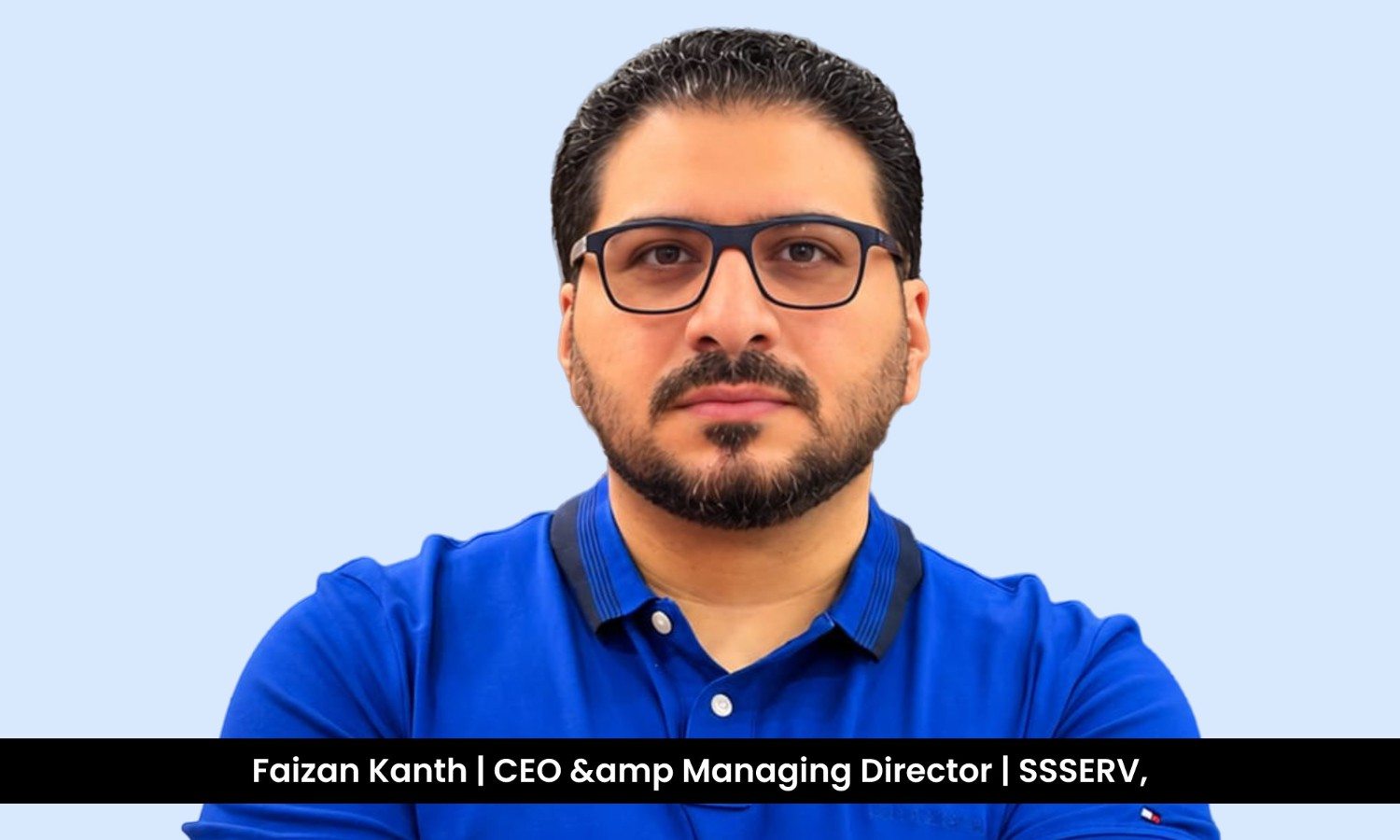
When you meet powerful men or simply read about them in the newspapers you often see the position before you see the person. You see the title, the organisation, the decisions, the achievements. What you rarely see is the thinking that happens underneath it all. It includes the principles that shape those decisions, the lessons learned when no one was watching, and the discipline required to keep moving forward when the path is anything but linear.
For Faizan Kanth, Founder & CEO of SSGServ, leadership begins much closer to the ground. “My truth is that you learn the most when you stay close to the ground,” he believes. It is a philosophy shaped by experience and reinforced by a deep understanding of systems, people and processes.
For Faizan, building a strong organisation is not about endlessly adding people, layers or processes. It is about creating an institution that can stand stronger than any single individual. It is about knowing when to empower, when to decide, and when to step back and let the system work. His leadership philosophy is deceptively simple. It comes down to staying close to the ground, understanding the system, and never compromising on integrity.
That thinking also extends to the way he approaches efficiency and innovation. His belief in “doing more with less, but never compromising on the outcome” reflects a practical, rather than fashionable, approach to transformation. His Lean Six Sigma background has shaped the way he sees operational excellence, while his growing fascination with the Just-in-Time model reflects a constant search for smarter ways of working.
Even when it comes to AI and automation, his perspective remains grounded. Technology, for Faizan, is not about adopting the newest tool simply because it is new. It is about identifying what is broken, understanding why it is broken, and asking how intelligently it can be fixed.
And perhaps that is where his idea of leadership becomes most revealing. If something is broken, the first question should not be, “Whose responsibility is this?” It should be, “How do we fix it?”
This is the story of Faizan Kanth beyond the designation. It is a conversation about leadership without layers, efficiency without compromise, technology with purpose, and the kind of legacy that survives the individual who builds it.
Staying Close to the Ground
For Faizan leadership has always begun at ground zero. His early career taught him the importance of staying close to the ground. He believes that a business cannot truly be understood from a distance. To understand an organisation, one has to see how the work actually happens. That means understanding how customers experience the organisation, how employees interact with processes, where decisions slow down, and where small inefficiencies eventually become larger problems.
That is why Faizan has always preferred to get involved from the ground up. He believes in understanding the details before making the big decisions not because a CEO needs to manage every detail, but because the right strategy cannot be built without understanding the reality underneath it.
That approach has remained central to his thinking as SSGServ has grown. Along the way, he also learned an important lesson. People are the real operating system of an organisation. Processes and technology may provide the framework, but ultimately, people make decisions, solve problems and shape the customer experience. Alongside this philosophy sits another value that remains non-negotiable for Faizan, integrity.
For him, integrity is not a statement displayed on a wall. It is reflected in what a leader does under pressure, when a decision becomes commercially difficult, or when nobody is watching. A business can be built through capital, technology, talent and strategy, but sustainable institutions, in his view, are built on trust. His leadership philosophy therefore comes down to three principles. Stay close to the ground, understand the system, and never compromise on integrity.
The Discipline of Doing More with Less
Faizan’s Lean Six Sigma background is not something he keeps separate from the way he runs a business. Over time, it has become part of his operating instinct. He has always had a strong preference for lean organisations. He does not believe that adding people, layers or processes automatically makes an organisation stronger. In many cases, he believes, the opposite can happen. Complexity begins to create its own cost. His thinking has increasingly evolved around a simple principle. Do more with less, but never compromise on the outcome.
Perhaps one of the ideas that resonates most strongly with him today is the Just-in-Time model. He is drawn to the discipline behind JIT, the idea that organisations should not build excess capacity simply because they might need it. Instead, they should build and deploy capability when the requirement exists, while designing the organisation to respond quickly when demand changes.
For Faizan, this is more than an inventory philosophy. It is a leadership philosophy. Why carry unnecessary layers? Why maintain processes that no longer add value? Why build capacity months or years ahead of demand? Why have five steps when three can achieve the same outcome?
These questions reflect the practical application of his Lean Six Sigma thinking. He constantly looks for waste whether it is wasted time, money, movement, duplication, unnecessary decision-making or underutilised talent. But being lean, he is quick to emphasise, does not mean being cheap. A lean organisation is not simply one with fewer people. It is one where every resource has a purpose and every process has a reason to exist.
As SSGServ continues to scale, Faizan wants the organisation to retain that discipline. For him, growth should not automatically translate into bureaucracy.
Start Lean. Prove Value. Then Scale.
This philosophy also informs his interest in the Micro GCC and hub-and-spoke model. Faizan believes organisations do not necessarily need to build massive capabilities upfront. They can begin with the capability they actually need, build it well, measure it, learn from it, and then scale it. The philosophy is straightforward. Start lean. Prove value. Create capability. Then scale.
For Faizan, that is not merely an approach to business expansion. It is a way of building organisations that remain agile, purposeful and resilient as they grow.
From Moving Work to Building Capability
For Faizan, the defining gap he observed over the years was the difference between simply outsourcing work and actually building capability. He increasingly became convinced that organisations did not always need another vendor to take processes away from them. What they needed was a partner capable of helping them build capabilities that could become an integral part of their long-term organisation. That distinction became central to his thinking.
Rather than approaching a client with the question, “What work can we take from you?”, Faizan prefers to ask a more fundamental one. “What are you trying to build, and how can we build that capability with you?” That philosophy naturally led him towards the Global Capability Centre (GCC) model. But Faizan believes the GCC conversation is now ready for its next evolution.
Historically, GCCs have often been associated with large centres established in major, traditional locations. Faizan sees a significant opportunity in Micro GCCs, which are smaller, specialised capability centres that can be established quickly, demonstrate value, and scale organically. The idea has particular relevance for India.
India has already demonstrated its ability to serve as a global capability powerhouse, but Faizan believes its strength extends far beyond a handful of established cities. There is enormous talent distributed across the country, and the opportunity lies in connecting those diverse talent pools with global enterprises. He puts the distinction simply, “Outsourcing moves work. A GCC builds capability.”
For Faizan, a truly embedded GCC should feel like an extension of the enterprise itself. The people working within it need to understand the client’s customers, culture, business objectives and long-term strategy. It should not feel like an external team operating somewhere on the other side of the organisational model. At the same time, he challenges the assumption that a GCC must necessarily be one enormous centre. He sees the future as increasingly distributed, specialised and connected.
This is where the Micro GCC and hub-and-spoke model becomes particularly powerful. A central hub can provide governance, technology, leadership, security and shared capabilities, while specialised spokes can operate across different talent ecosystems. Such a model not only broadens access to talent but can also create greater organisational resilience.
For India, Faizan believes this could be transformative. The country has already proven that it can support global enterprises at scale. The next opportunity, in his view, is to make India’s entire talent ecosystem globally accessible, rather than concentrating capability within a few traditional hubs. His philosophy is not about standardising everything. It is about standardising what truly matters. “Standardise the architecture, not necessarily the environment.”
Quality, governance, security, accountability, reporting and ethical standards should remain consistent wherever the organisation operates. But the way people communicate, collaborate and build relationships should have room for local context. For Faizan, local culture is not an obstacle to globalisation. It can be an advantage. India is a powerful example with its diversity of languages, cultures, educational backgrounds and talent pools. The challenge is not to eliminate that diversity, but to connect it.
That is precisely where the hub-and-spoke model fits into his larger vision. One common operating architecture, connected to multiple local talent ecosystems. Because, as Faizan sees it, one standard does not have to mean one location.
One Organisation, One Accountability
For Faizan, the customer never experiences an organisation the way an organisation experiences itself. They do not see engineering, technology, customer experience, or operations as separate functions. They see one organization and their experience is shaped by how seamlessly those functions work together. That belief has made shared accountability a central part of Faizan’s leadership philosophy.
Technical teams, he believes, must understand the customer impact of their work. CX teams must understand how technology can improve the customer journey. And leadership must ensure that these teams are ultimately measured against the same outcomes. The question, therefore, should never be, “Whose problem is this?” It should be, “What is the customer experiencing, and what do we collectively need to do about it?”
This becomes even more critical within smaller, specialised Micro GCCs. Faizan does not believe meaningful capability requires thousands of employees. It requires the right people, the right technology, the right governance, and the right culture. He also rejects the idea that speed and quality must exist in opposition. The real discipline, in his view, is knowing what can never be compromised and what should remain open to continuous improvement.
For Faizan, the non-negotiables are clear. Integrity, customer commitment, quality, security, and accountability. Everything else should be open to examination.
Build Small. Learn Fast. Then Scale.
The same philosophy extends to how Faizan approaches capability building. He believes organisations should build a capability before attempting to scale it. The process is deliberately simple. Build small, learn quickly, standardise what works, and then scale. It is essentially the philosophy behind the Micro GCC model.
Instead of making a massive commitment at the outset, an organisation can establish a focused capability, prove its value, learn from the experience, and expand once the model demonstrates that it works. For Faizan, this creates an important balance. Speed without sacrificing the foundations required for sustainable scale.
A Distributed Future for Global Capability
Faizan sees the next generation of global capability as distributed, specialised, lean, and technology-enabled. The traditional model often assumes that organisations must make a significant upfront investment in one large centre. He sees another path. A company could establish a Micro GCC around a specific capability, such as engineering, CX, analytics, finance, or technology, build it well, demonstrate its value, and then expand. Multiple Micro GCCs could subsequently be connected through a common hub, creating a hub-and-spoke global capability architecture.
For India, Faizan believes this model represents a particularly significant opportunity. India has already established its position as a global talent destination. The next opportunity, he believes, is to unlock the depth of talent that exists beyond the traditional metropolitan centres. There are exceptional professionals across India’s Tier-2 and emerging cities. Connecting that talent with global businesses would mean more than simply creating additional delivery locations.
It could create new global economic corridors. And that, ultimately, is the larger opportunity Faizan sees. It is not merely distributing where work gets done, but creating a more connected, resilient, and geographically diverse global capability ecosystem.
Technology That Augments Humanity
For Faizan, the future is not a contest between humans and technology. It is about what becomes possible when technology augments human potential. He does not believe the most important question is simply, “What can we automate?” The more meaningful question is, “What should humans be spending their time doing?” If technology can perform repetitive activities faster and more accurately, Faizan believes organisations should embrace it. But judgement, empathy, creativity, leadership, and human relationships remain distinctly human strengths. These are not weaknesses of the human model. They are precisely what makes it valuable.
His approach to AI and automation is therefore pragmatic. Technology should remove friction, improve decision-making, and make people more productive. But the fact that something can be automated does not necessarily mean that it should be. Technology should remove friction, not remove humanity.
Ownership Beyond the Job Description
For Faizan, technology is only one part of organisational transformation. The other is the mindset of the people using it. He wants employees to think beyond their formal job descriptions. When someone sees something that is broken, the instinct should not be, “That’s not my responsibility.” It should be, “What can I do about it?”
That does not mean everyone makes every decision. It means everyone understands that they have a stake in the outcome. For Faizan, this is where culture becomes real.
Culture cannot simply be announced by leadership. People observe what leaders actually do. When leadership takes responsibility, people learn ownership. When leadership blames others, people learn to protect themselves. And when leaders are transparent about mistakes, employees become more willing to identify problems before they become larger issues.
The culture he seeks to build is therefore one where people have both accountability and the confidence to challenge the status quo.
Resilience Beyond Cost Cutting
Faizan also believes that difficult markets reveal the true quality of an operating model. When uncertainty rises, the immediate instinct for many organisations is to cut costs. But he makes an important distinction. Cost reduction and optimisation are not the same thing. Reducing expenditure can sometimes mean reducing capability and in doing so, weakening the organisation’s ability to respond when conditions improve.
Instead, Faizan looks at three fundamental questions.
Where are we creating value?
Where are we creating waste?
And what capabilities will we need when the market changes again?
The answers will not always be the same. Sometimes the right response will be automation. Sometimes consolidation, restructuring, or a change in location strategy.
Increasingly, Faizan sees distributed capability as another important element of organisational resilience. A hub-and-spoke model can give organisations access to multiple talent pools while reducing excessive dependence on a single location. It creates flexibility not simply in where work happens, but in how organisations respond to uncertainty.
For Faizan, the objective during a downturn should not simply be to become smaller. It should be to become leaner, smarter, and more resilient.
Building a Legacy Beyond Scale
For Faizan, the ambition for SSGServ extends far beyond opening more offices or increasing headcount. He wants SSGServ to be recognised as an architect of global capability, an organisation that helps reshape how global businesses access talent, build specialised capabilities, and create long-term value. When he looks five to ten years ahead, Faizan does not envision a world defined simply by larger centres and larger teams. He sees a much more distributed GCC ecosystem.
Large strategic hubs will continue to play an important role. But alongside them, he believes there will be a growing network of Micro GCCs focused on specific capabilities and connected through a common operating architecture.
And India, in his view, has an extraordinary opportunity to shape that future.
India’s global presence is already undeniable. The next chapter, however, could be about taking that global capability deeper into the country. Faizan does not believe businesses should have to choose between India’s Tier-1 cities and its emerging locations. The opportunity is to connect them.
That is where the hub-and-spoke model becomes powerful. A global organisation could have a central capability hub supported by multiple specialised spokes across India, each accessing different pools of talent, expertise, and local strengths. The model creates opportunities for businesses but equally importantly, it creates opportunities for people.
And that distinction matters to Faizan.
He does not want the story to simply be about building more centres. He wants it to be about making global opportunities accessible to more people and more places.
A Legacy Built Through People
Ultimately, Faizan’s definition of legacy is not measured by the number of offices established or the scale of an organisation. It is more personal.
He wants to build institutions that are stronger than any individual. He wants to develop people who become better leaders because they were given the opportunity to take ownership. And he wants to demonstrate that it is possible to build a successful global business without compromising the values that made that success possible.
His own journey has taught him that progress is rarely linear. There are periods of extraordinary confidence, and there are periods when the goal is simply to get through the day and keep moving forward.
What matters, he believes, is continuing to learn, continuing to show up, and continuing to build. That philosophy perhaps captures the essence of Faizan’s leadership journey. It is progress without losing perspective, growth without abandoning values, and ambition without losing sight of people. Years from now, if the story is that he helped build organisations defined by integrity, resilience, and genuine ownership, and that he helped open global opportunities to talent beyond the traditional centres, Faizan would consider that a meaningful legacy.
Because for him, the ultimate measure of leadership is not how large an organisation becomes under one person’s direction. It is how much stronger the people, institutions, and opportunities become because that person helped build them.